
Your listing went live on a Tuesday. By the next Monday three showings had come and gone, nobody had called, and your agent’s last text was a thumbs-up emoji from six days ago. That silence is data. Almost every seller I’ve bought from in this spot could pinpoint the exact week they realized they’d hired a bad realtor, usually about sixty days too late to fix it cheaply.
What Are the Warning Signs of a Bad Realtor?
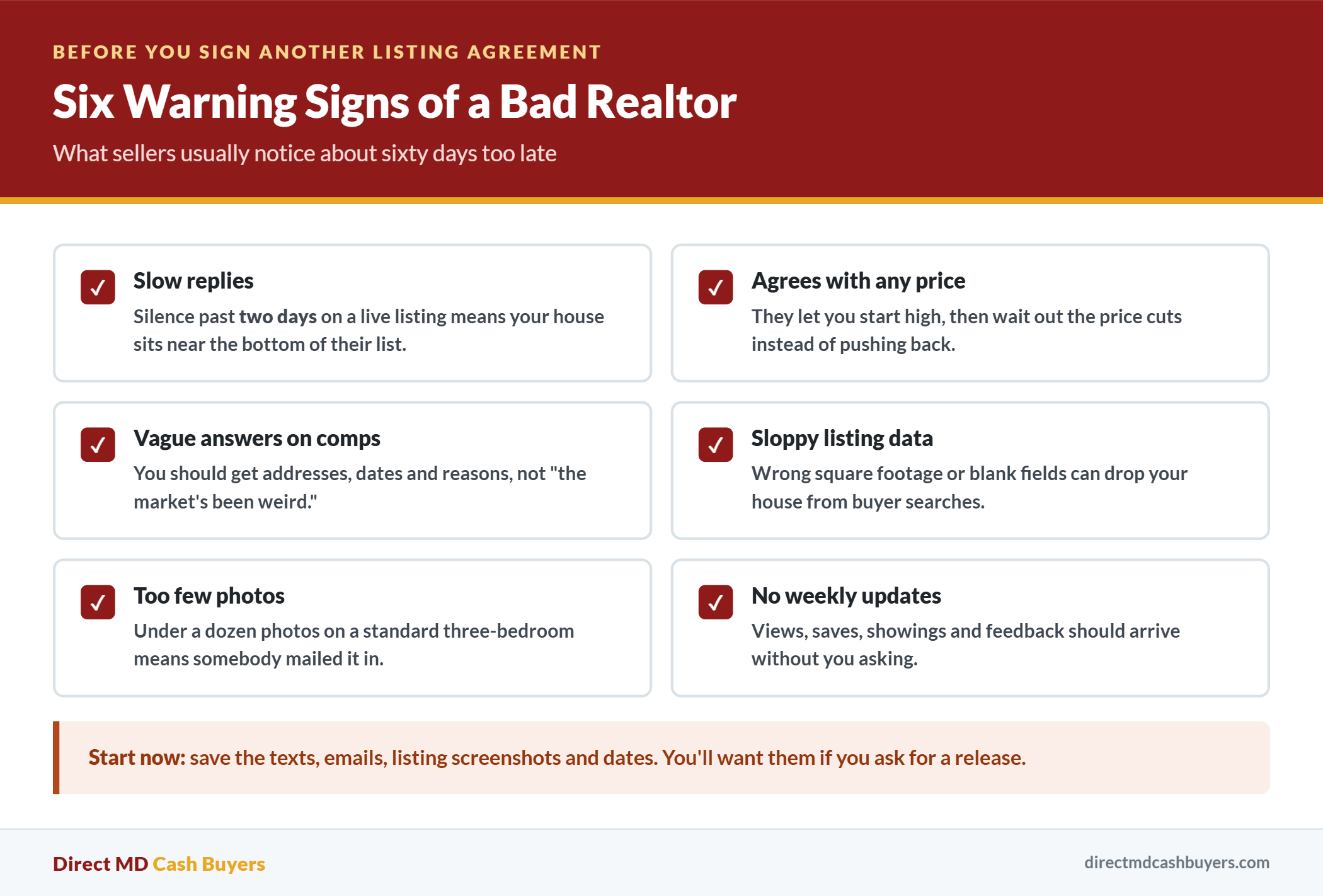
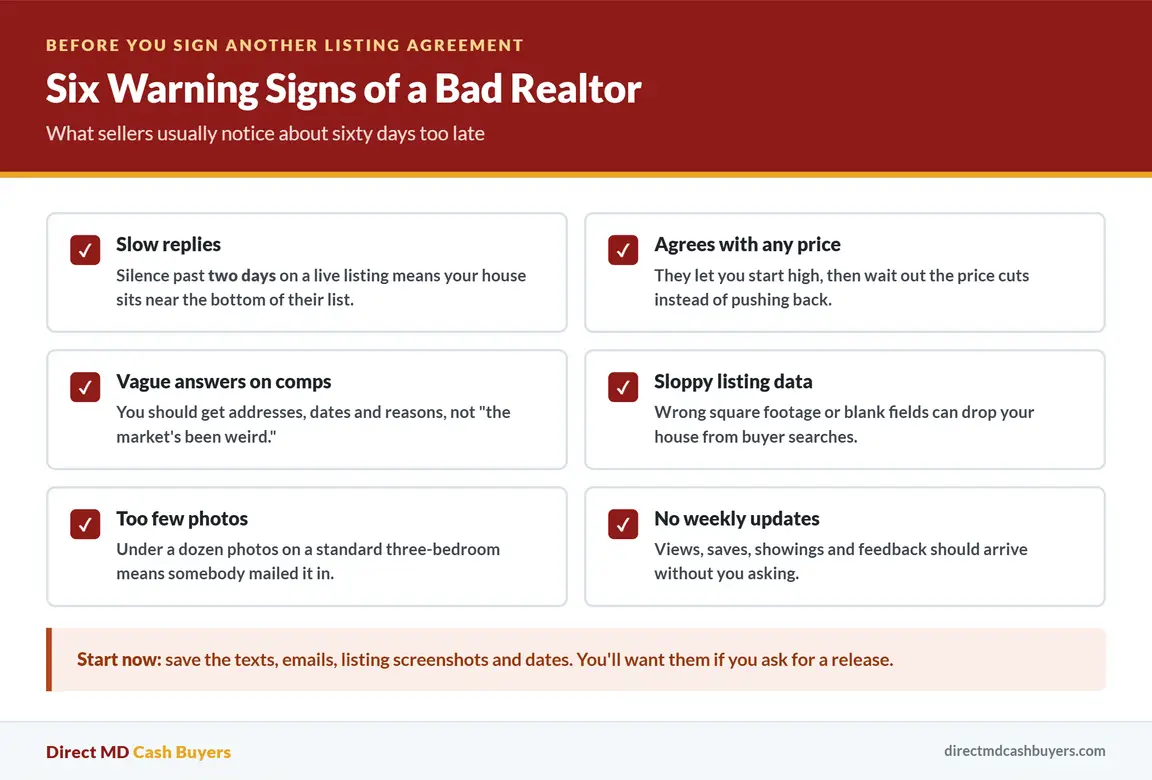
The earliest tell is almost never a botched contract. It’s responsiveness. Even “I don’t know yet, give me till tomorrow” counts as an answer, and a good agent gives one within a few hours. Silence stretching past two days on a live listing means your property sits somewhere near the bottom of their priority stack.
Watch how they price, too. An agent who agrees with whatever number you throw out isn’t backing your judgment. They’re dodging a hard conversation to win the listing. A bad realtor will let you start thirty grand high, wait out the price cuts, and never admit the first number was theirs to push back on.
Today’s market makes that mistake costlier. NAR reported on November 12, 2026 that October existing-home sales fell to a seasonally adjusted annual rate of 3.75 million. Homes sat a median of 35 days on market, up from 34 days a year earlier. Buyers have choices, and in a market like this overpricing doesn’t cost you a week. It costs you the whole first wave of attention.
Early last year I bought a small ranch from a widow whose agent had told her to redo the kitchen first. The contractor’s estimate came back higher than the kitchen itself was worth in that neighborhood. Nobody had run the numbers before telling her to spend them.
Vague answers are another signal. Ask what comparable homes closed for in the last ninety days, and you should get addresses, dates, and reasons. If all you get is “the market’s been weird,” someone’s managing you instead of representing you. A bad realtor leans hard on generalities because specifics invite follow-up questions they can’t answer.
How Do You Spot a Bad Real Estate Listing From a Bad Realtor?
Pull your property up on Zillow the way a stranger would, on a phone screen without logging in. The thumbnail matters most. That single image decides whether anyone taps through at all. If the lead photo is a dim shot of your driveway or a bathroom mirror, the listing’s already losing.
Now look at the facts. Wrong square footage, missing bedroom counts, a blank lot size, and an empty school district field all point to a bad realtor who filled out the MLS form in four minutes between other appointments. Those fields drive search filters. One empty field can quietly remove your house from an entire set of buyer searches, and you’d never know it happened.
Status errors matter as well, like a property still marked “coming soon” two weeks after showings started, or an open house date that already passed. Buyers reading that assume nobody’s minding the store, and plenty of them are right.
Then pull up two or three competing listings in your price range on that same phone. If theirs look sharper, your agent is costing you the comparison before a buyer ever schedules a tour.
One more thing is worth checking. Does the listing appear anywhere besides the MLS feed? Look for syndication to the major portals, a social post, or an email to the agent’s buyer list. Those cost nothing but effort, which is exactly why a bad realtor skips them.
Why Does a Bad Realtor Only Post Limited Photos?
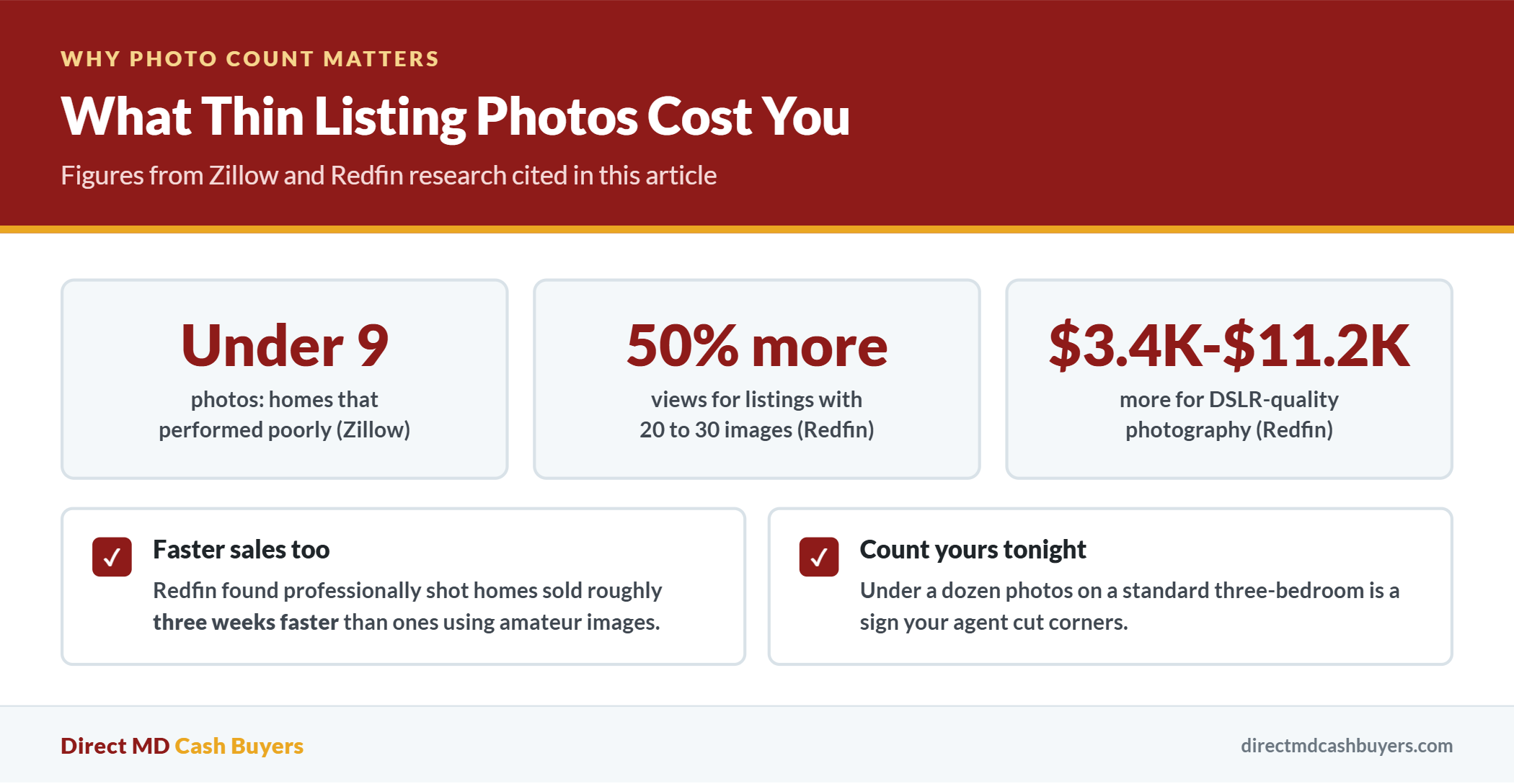
You might think the pictures hardly matter, since serious buyers tour in person anyway. They don’t get that far. Zillow’s research found homes with fewer than nine photos performed poorly compared to listings in the 22 to 27 range. Redfin data showed listings with 20 to 30 images pulled in 50% more views than thinner ones. No views means no showings, and no showings means no offers.
So why does a bad realtor post six?
Mostly cost and time. A photographer runs a couple hundred dollars out of the agent’s own pocket. Skipping it saves the agent money today and costs you money at closing. Redfin’s study found homes shot with DSLR-quality photography sold for $3,400 to $11,200 more. They also sold roughly three weeks faster than listings with amateur images.
Buyers fill photo gaps with worry. Leave out the second bathroom and your perfectly fine one becomes a question mark. Question marks come back as lowball offers.
If your house genuinely needs work, I’d rather see it photographed honestly than cropped into a mystery. Investors like us buy properties in rough shape all the time, so a clear set of pictures speeds everything up. Sellers who want a straight as-is conversation without a photo shoot can get one from a local buyer like Direct MD Cash Buyers without ever putting the property on a portal.
Count your photos tonight. Under a dozen on a standard three-bedroom means somebody mailed it in.
Why a Poor Property Description Signals a Bad Realtor
Four hundred characters. That’s roughly how long a lazy listing description runs, and it reads like a tax form: three bedrooms, two baths, large yard, must see. Meanwhile the national median existing-home price hit $416,700 in October 2026, up 0.4% from a year earlier. You’re asking a buyer to spend near that number based on a paragraph shorter than a pizza order.
Good descriptions do specific work. They name the roof year, the new panel, the fenced side yard, and the way morning light hits the kitchen. Buyers get their questions answered before they’d ever need to call. A bad realtor who doesn’t want calls writes short for exactly that reason.
Typos tell on people, and so do copy-paste errors like a basement mentioned for a house on a slab. Each one came from a template nobody bothered to edit.
Watch for words like “charming” and “cozy” doing all the heavy lifting. They usually mean the agent didn’t walk the property closely enough to find anything concrete to say. A bad realtor writes from the listing sheet instead of from the house.
I keep running into the same thing with longtime owners. Sellers who’ve lived somewhere twenty years know a dozen selling points their agent never asked about, from small upgrades to the reasons the block stays quiet. Nobody collected that information, so none of it reached a single buyer.
If the description doesn’t sound like your house, rewrite it and send it over. An agent who resists that edit is telling you something.
What Do Multiple Relistings Say About a Bad Realtor?
The script usually runs like this: six months of marketing, a few price drops, then a fresh listing with a reset day count and a cleaner-looking history. On paper it’s a strategy.
Almost always, the underlying issue is price, presentation, or access, and none of those change just because the listing number did. A bad realtor relists because relisting is easier than telling you the number has to come down fifteen thousand dollars.
Hold your listing up against that national median from earlier. A property crossing ninety days without a single offer isn’t a victim of timing. Something specific is wrong, and your agent should be able to name it. Mortgage rates have stayed above 7% since mid-September, and homes are sitting longer as buyers wait for relief. That’s real, but it doesn’t explain a listing with zero showings.
Ask for the showing history. How many tours were there? What did the buyer’s agents say? If you hear that feedback forms “usually don’t come back,” push harder. Lack of feedback is itself the feedback.
Taking the house off the market is a fair move if you want out. Just know what’s happening before you sign another six-month agreement with the same bad realtor who produced the first six.
How Does a Bad Realtor Handle Buyer Questions?
A buyer’s agent calls Thursday asking about the age of the HVAC. Nine days pass, the buyer writes an offer on a different house, and your agent never mentions the call happened.
Buyer questions are buying intent in its earliest form, and a bad realtor treats them as interruptions. Sales die in the gap between a question asked and a question answered.
Pay attention to how your agent fields your own questions, because that’s your preview of how they’ll handle everyone else’s. Look for short replies, deflection, and a habit of answering a different question than the one asked. The buyer’s agent on the other end gets the same treatment and simply moves on to the next property.
I once bought a house from an owner whose listing agent had let three separate septic inquiries sit unanswered for over a week. She found the emails herself after a frustrated buyer’s agent copied her directly.
An agent who guesses at permit status or lot lines creates a disclosure headache later. The NAR Code of Ethics also covers how offers get presented and what an agent has to disclose. Guessing isn’t a style quirk. It’s exposure, and it lands on you as the owner of record.
What’s your agent’s actual response time to a buyer at 7pm on a Saturday? If you don’t know, ask them directly. Their answer, and how comfortable they seem giving it, tells you plenty about whether you’ve hired a bad realtor or a professional.
Is No Additional Information a Red Flag From Your Realtor?
“Am I supposed to be hearing more than this?”
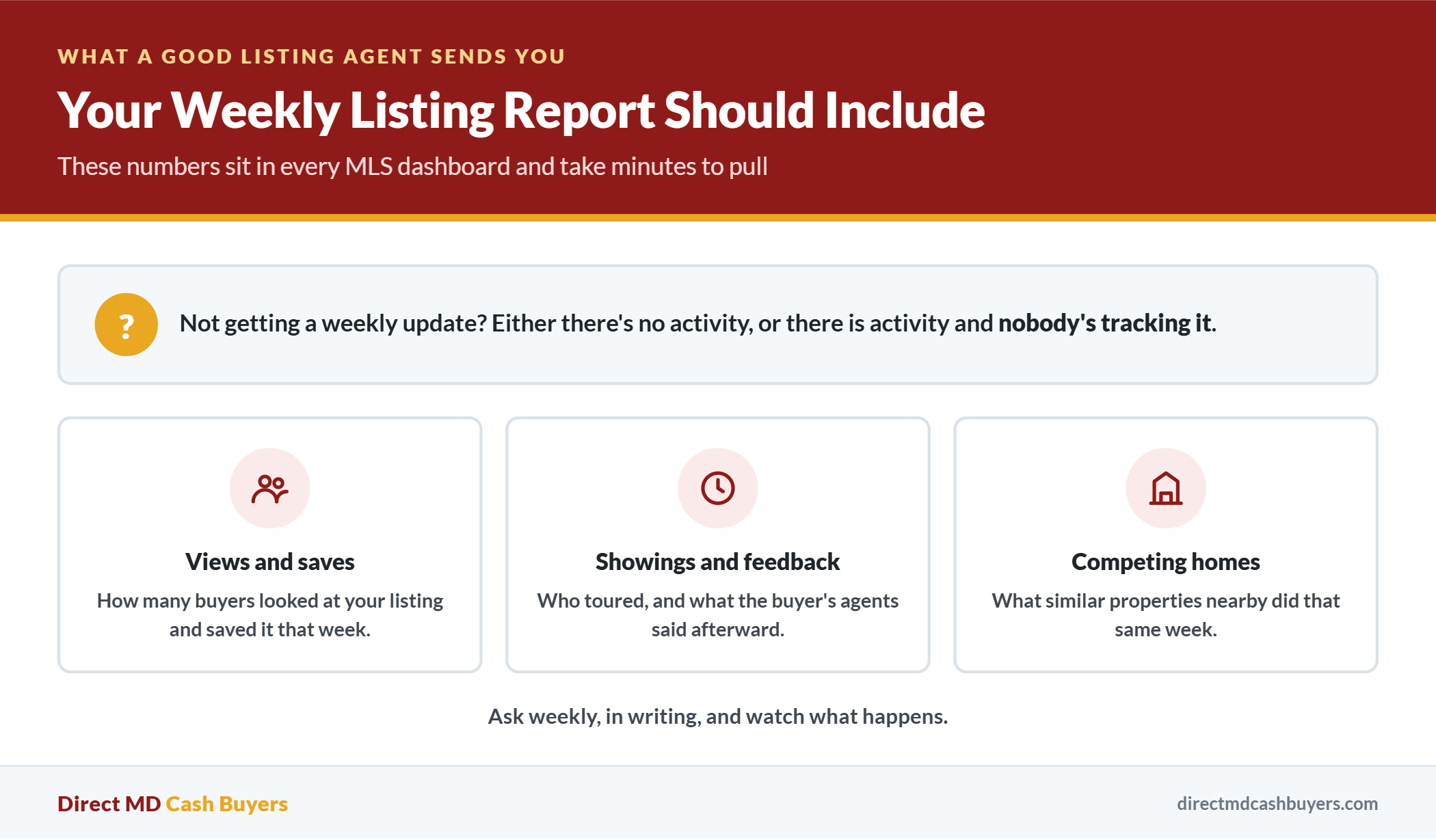
Yes. A listing agent should send you something weekly without being asked: view counts, saves, showing requests, feedback, and what competing properties did that week. Those numbers exist in every MLS dashboard and take four minutes to pull.
Either there’s no activity to report, or there is activity and nobody’s tracking it. A bad realtor prefers you not know which.
Telling you the property got eleven views in a week invites a pricing conversation. They’d rather put that off until you’re tired enough to accept any offer. Quiet is a negotiating position, just not one aimed at the buyer.
Reread your listing agreement now, since most spell out marketing commitments clearly. Plenty of sellers discover their bad realtor never delivered the professional photography, open houses, or print pieces promised in writing. That gap is leverage, and it’s the cleanest basis for asking a broker to release you early.
Next, check the agent’s track record. Skip the website testimonials and pull their closed listings, then look at day counts and price-cut history. Cash sales made up 27% of transactions in September 2026, so a few quick closings in an agent’s history aren’t unusual. A long string of properties that lingered and limped to closing is different. It’s a reliable predictor of what’s about to happen to yours.
Ask for updates weekly, in writing, and watch what happens.
What Should You Do After Spotting a Bad Realtor?
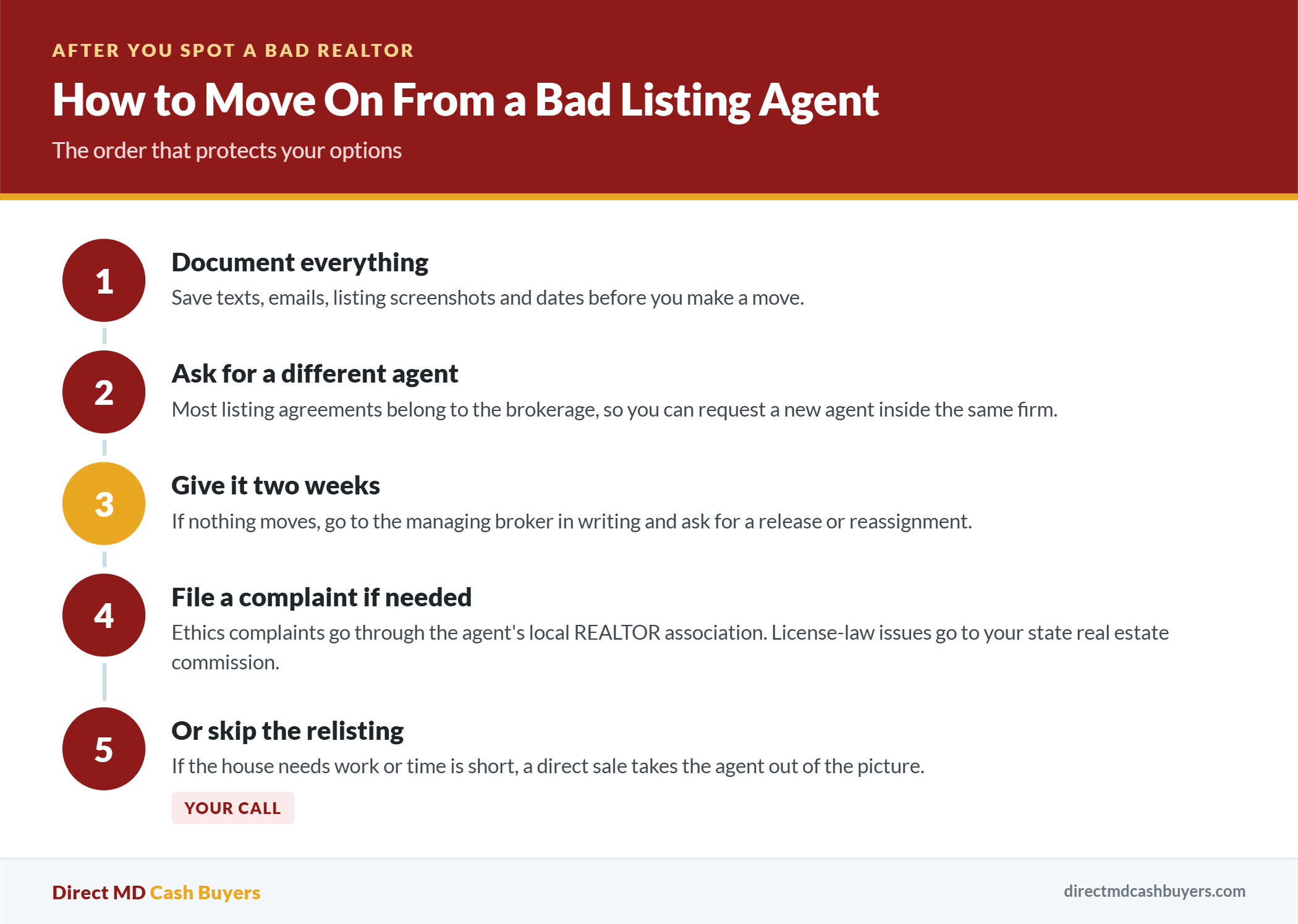
Most listing agreements belong to the brokerage, not the individual agent. That opens up your options, since you can request a different agent inside the same firm. Brokers grant that more often than people expect, because an unhappy seller is a liability they’d rather not carry.
Give the new arrangement two weeks. If nothing moves, go to the managing broker in writing and ask for a release or reassignment.
Only REALTORS® and REALTOR-ASSOCIATE®s fall under NAR’s Code of Ethics. If your agent or their broker isn’t a member, your recourse runs through your state licensing authority or the courts. Ethics complaints get filed through the local association of REALTORS® where that member belongs. Each filing has to cite which of the seventeen Articles you believe were violated. License-law issues go to the state real estate commission. The NAR complaint resources page walks through both paths, and the commission’s own site will tell you what its form requires.
An heir I worked with had just moved his father into assisted living. The house still held the man’s woodworking bench and half a cord of firewood in the garage. He’d been through two listing agents in five months and had no appetite for a third. A direct sale let him close on a Friday, so he spent his weekends visiting his dad instead of meeting photographers.
Top dollar with the right agent is a genuine path. I’ll say plainly that a strong listing agent beats a cash offer on price almost every time. Price isn’t the only variable, though. If the house needs work you can’t fund or the timeline is tight, a direct offer from a buyer like Direct MD Cash Buyers removes the agent from the equation entirely. No relisting, no photo count, and no waiting on a callback.
Whatever you decide, document the history before you move. Save the texts, the emails, the listing screenshots, and the dates. You’ll want them if you ask for a release, and you’ll want them if you file anything later.
Frequently Asked Questions
How Do You Report a Bad Realtor?
Start with the managing broker at the firm, since many issues get resolved internally once leadership knows about them. If that goes nowhere and your agent holds REALTOR® membership, you can file an ethics complaint through their local association. It has to be in writing and signed in your own name. For license-law violations, your state real estate commission takes complaints directly and can issue fines or discipline. Those two channels are separate, and filing with one doesn’t start the other.
What Is the 80/20 Rule for Realtors?
It’s the observation that a small slice of agents handles most of the transactions in any given market. For you as a seller, that means experience is wildly uneven across licensees. Plenty of people holding a license close only a handful of sales a year. Before you sign anything, ask how many homes the agent personally closed in the past twelve months and in what price range. Hesitation on that question is useful information.
How Long Should I Wait Before Firing a Bad Realtor?
Give it about three to four weeks of active marketing, with a clear written list of what you want corrected. That’s enough time to see whether the photos got replaced, whether showings started, and whether reporting shows up. If the listing still drifts past that point with no activity and no explanation, asking the broker for a release isn’t impatient.
Can I Be Charged a Commission After Switching Agents?
Possibly, depending on how your agreement reads. Many listing contracts include a protection period. If a buyer who toured during the original listing comes back and closes shortly after, the first brokerage may still be owed. Ask for that clause in writing and read it before you sign with anyone new. An attorney in your state can tell you how it applies to your specific contract.
Does a Bad Realtor Hurt My Price or Just My Timeline?
Both, and they’re connected. A property that lingers invites price reductions, and reductions invite lowball offers from buyers who read a long market history as desperation. Carrying costs keep running the whole time: mortgage, taxes, insurance, and utilities. The damage from a bad realtor shows up on the closing statement, not just the calendar.
Should I Just Sell As-is Instead of Finding a New Agent?
That depends on the house and your situation. If the property shows well and you have the time, a strong agent will likely net you more than a direct offer. Maybe the repairs are beyond your budget, the timeline is short, or you’re simply done with the process. In that case a straightforward as-is sale is a reasonable call rather than a concession.
If you’ve already been through one bad realtor and aren’t sure you want to start over, we’re glad to talk it through with you. Tell us about the house, what shape it’s in, and what you hope to accomplish. We’ll give you a straight read on whether listing again or selling directly makes more sense for you. If it’s listing, we’ll say so, with no pressure, no obligation, and no follow-up calls you didn’t ask for.
What Maryland Sellers Are Facing Right Now
Maryland REALTORS reported a median sale price of $445,000 in August 2026, up 2.3% from a year earlier. Sales dropped 8.5% over the same stretch, so a listing with weak photos and slow replies gets passed over faster.
When your agent has gone quiet, you can still sell your Maryland house without relisting it.
We also buy homes around Baltimore and across the rest of the state, in any condition.
Tired of Chasing Your Agent?
You don’t have to sign another six-month listing to get the house sold. Tell us about the property and your timeline, and we’ll give you an honest read on which route fits.
Reach out to Direct MD Cash Buyers or fill out the form below. There’s no obligation, and we won’t push you either way.