
A pest control tech once handed a seller a report with the word “active” circled twice, and the seller figured his sale was dead on the spot. It wasn’t. You can sell a house with termites, and houses like his change hands every day, through agents, through investors, and through family members buying out siblings. The insects rarely sink the transaction. Sellers do, by panicking and spending money in the wrong order, or by hiding what they know and watching the whole thing unravel at closing.
I’ve been buying houses for years, and wood damage shows up more often than almost any other surprise. What it really costs you, what you’re obligated to say, and how to get out without handing your equity to a contractor all come down to a few early choices.
Should You Get a Termite Inspection Before Listing?
If I were sitting at your kitchen table with a cup of coffee, I’d tell you to order the inspection before you do anything else. You can’t price a house around a problem you haven’t measured.
A wood-destroying organism report gives you numbers instead of nightmares. Your buyer will order one anyway in most transactions, especially with government-backed financing involved. Would you rather learn the scope on your own timeline, or three days before a contract deadline while a buyer’s agent drafts a repair demand?
Sellers get tripped up on who does the work. A general home inspector isn’t the right person for this in Maryland. State law treats a wood-destroying insect inspection as pest control, so only a company licensed by the Maryland Department of Agriculture can do it. The results go on Form MD-1, the state’s own report for a sale or a loan. Call a licensed pest company, not a handyman.
One thing surprises people. No state law requires a buyer or seller to get a termite letter, according to the industry reference at TermiteRegistry. Any requirement you run into comes from your lender or your purchase contract. The inspection is your choice, not a legal hoop.
Routine inspections run a few hundred dollars. Annual checks typically cost around $300 to $500 and can head off thousands in repairs. That’s a cheap education about your own house.
Last year I bought a place from an out-of-state heir who was splitting assets in a divorce and wanted exactly one thing: the sale handled. The crawl space had the mud tubes you’d expect in a property nobody had checked in a decade. That didn’t surprise me, since plenty of these situations start the same way. She never saw the house, never ordered a report, and signed the paperwork from two time zones away.
Pre-listing inspections do carry one real downside. Once you know, you own that knowledge, and the next section explains why that matters.
Do You Have to Disclose Termites When Selling?
For a long time I assumed a seller could stay quiet about old damage if treatment had already been done. That’s flat wrong in most places.
Disclosure rules live at the state level, so the exact form and wording shift with where your property sits. The pattern holds, though. If a home has been treated for termites or other wood-destroying organisms, most states require that disclosure for a sale, per InterNACHI. That’s true whether the treatment happened last year or a decade ago, and repaired damage counts.
State forms ask the question directly. Maryland’s Residential Property Disclosure and Disclaimer Statement, required under Real Property §10-702, names wood-destroying insect infestation as its own item. Elsewhere the wording differs. Illinois requires a standardized report of known material defects before a purchase contract is signed, and insect damage the seller knows about counts as a material defect. Texas law obligates sellers of single-family homes to provide a Seller’s Disclosure Notice under Property Code §5.008. Pennsylvania’s Real Estate Seller Disclosure Law requires most sellers to hand over a Seller’s Property Disclosure Statement, and DocJacket has the state-by-state breakdown.
What triggers the duty is knowledge. Maryland’s statute, Real Property §10-702, asks about defects the seller has actual knowledge of, so a seller who doesn’t know about a colony in the crawl space has nothing to report on it. That’s the honest tension in pre-listing inspections. Knowing creates a duty.
My opinion, and plenty of agents disagree: disclose anyway, even where you might squeak by. Concealment claims and civil suits cost far more than termites ever will. Buyers who get the full picture upfront also tend to renegotiate less. A seller who hands over the pest report, the treatment receipt, and the warranty paperwork on day one looks like someone worth trusting.
Your real estate agent or a local attorney can confirm what your specific state form demands. Don’t guess at it, and don’t let anyone fill out that form for you.
How Much Do Termites Affect Your Home’s Value?
Price the house as though the problem is invisible, and you’ll eat the correction twice. It happens once when the inspection report lands, and again when the buyer walks and you relist as stale inventory.
Buyers don’t discount for insects. They discount for uncertainty, and they do it generously. A buyer looking at an unmeasured infestation mentally reserves for the worst case, which is usually several times the real repair figure.
Mortgage lending turns this into a hard stop rather than a haggle. FHA and VA underwriting generally won’t fund a house with an active infestation or unrepaired structural damage. Proof that the termites are gone and the damaged wood is repaired before closing becomes a common hurdle. Conventional buyers sometimes have more room, but appraisers flag visible damage and lenders react.
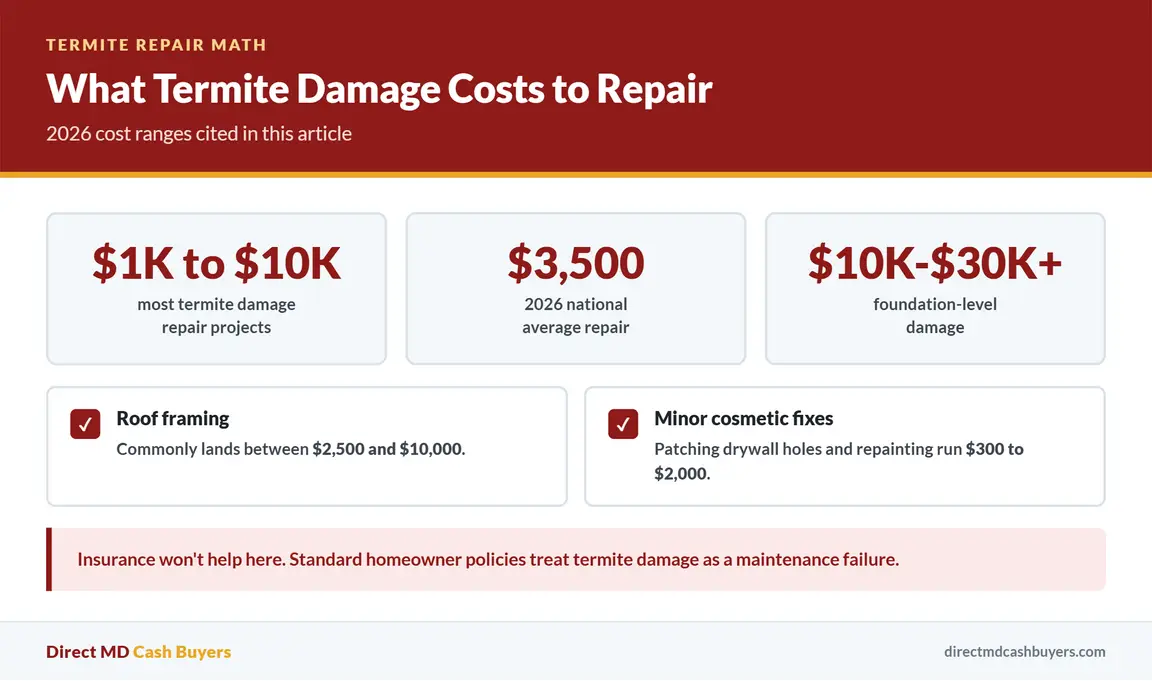
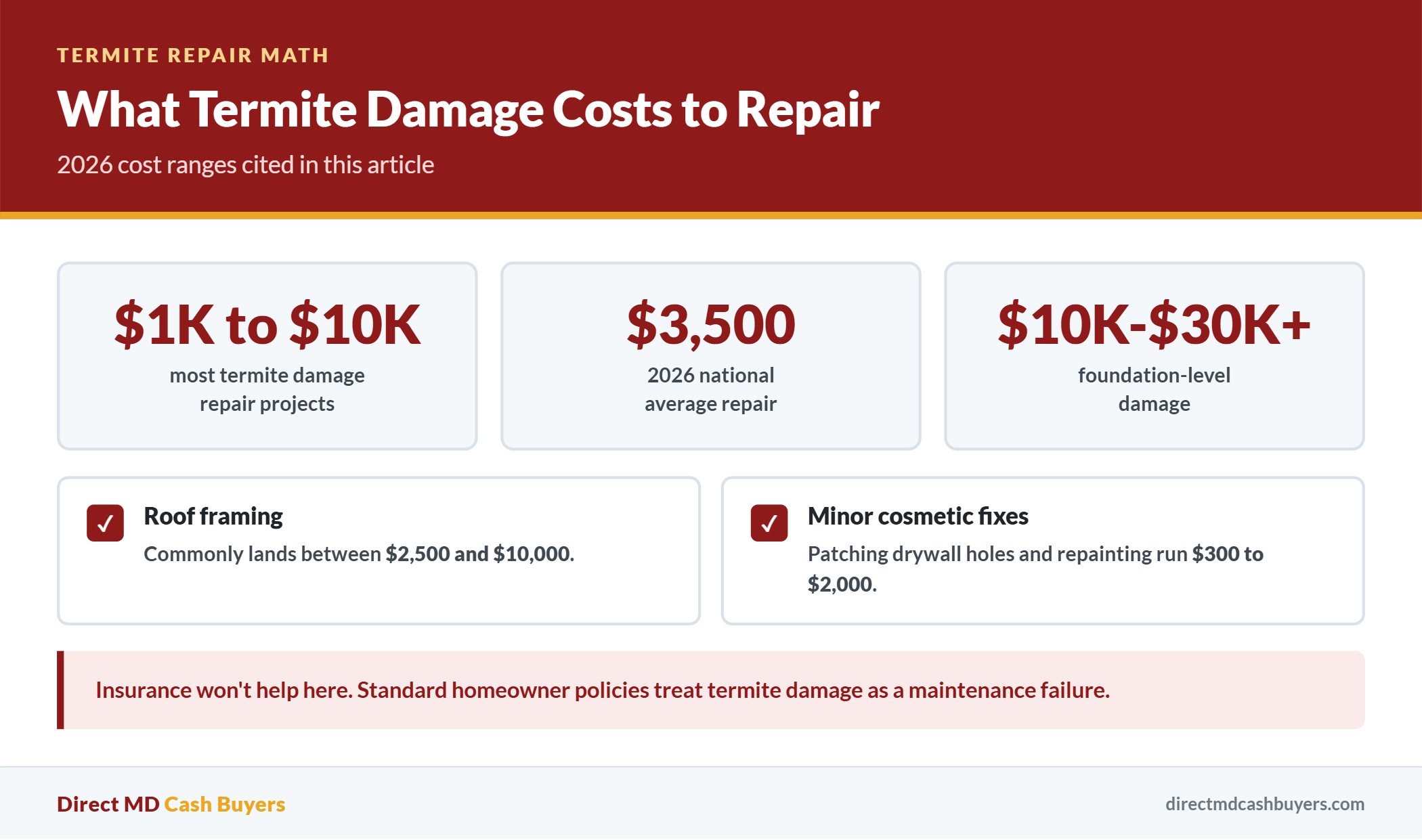
Then there’s insurance. Standard homeowner insurance policies exclude this entirely, treating termites as a maintenance failure instead of a sudden loss. Nobody is paying you back.
Repair math is what tells you the actual discount range. Most termite damage repair projects run $1,000 to $10,000, with a 2026 national average near $3,500. Foundation-level damage can run $10,000 to $30,000 or more, and roof framing damage commonly lands between $2,500 and $10,000. Next to a median existing-home price of $416,700 in October 2026, up 0.4% from a year earlier, a mid-range repair is a rounding error. A severe structural case takes a serious bite.
Your leverage comes down to market conditions. With a median of 35 days on market and a 5.1-month supply in October 2026, sellers hold less leverage than a year ago. Inspections and credits are negotiable in ways they weren’t at a 4.4-month supply, as United States Real Estate Investor reported.
Repair Termite Damage or Sell As-is: Which Costs Less?
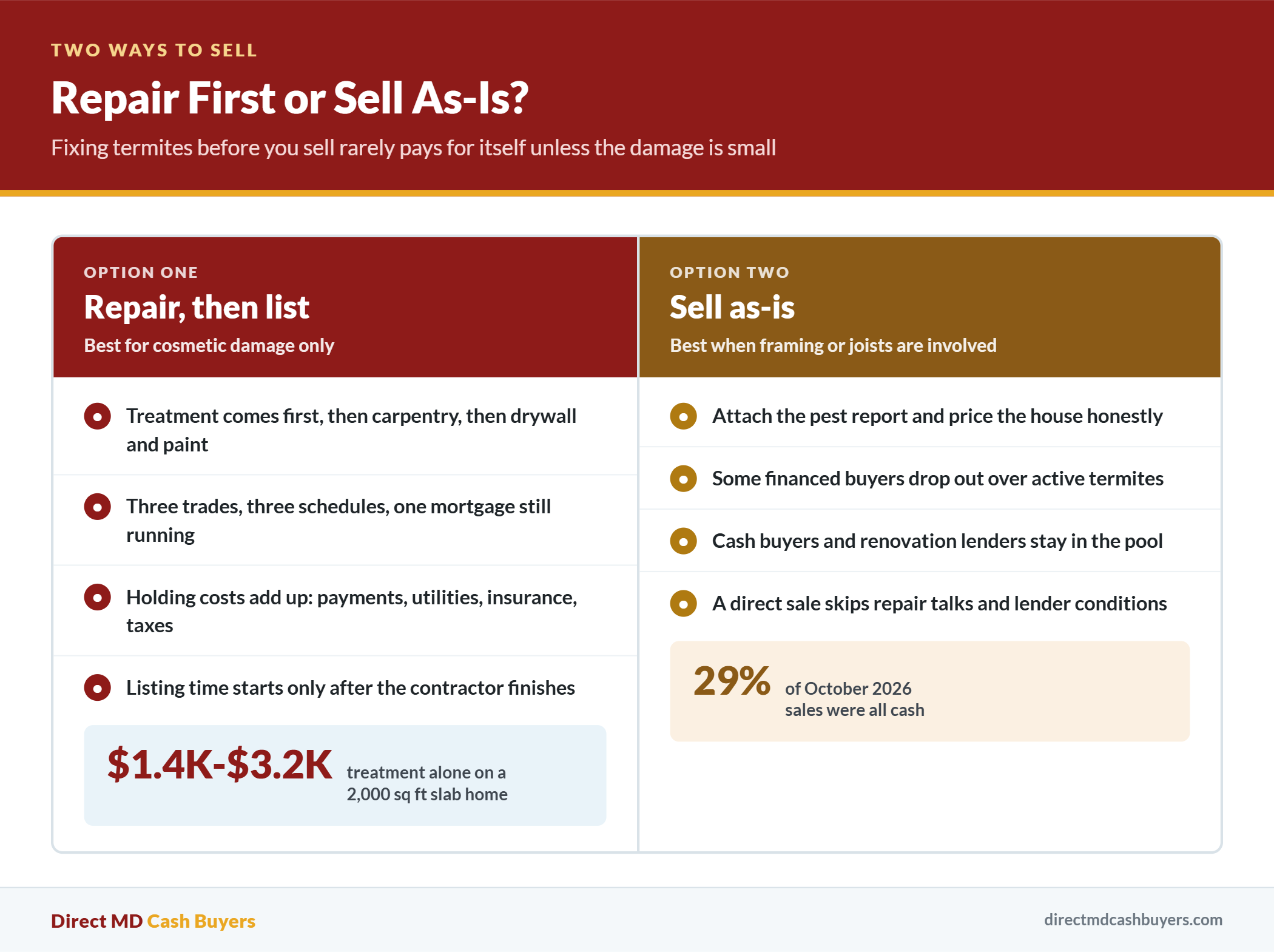
Fixing termites before you sell almost never pays for itself unless the damage is small and the house is otherwise retail-ready.
Treatment is the affordable half. A standard 2,000-square-foot slab home runs $1,400 to $3,200 for full subterranean termite eradication in 2026, and that part’s manageable on its own. The carpentry behind the walls is where budgets blow up. Nobody can price framing repair until they open the wall and see how far the galleries run.
Think about the order of work too. You can’t permanently repair termite damage without first killing the infestation. That means paying for treatment, waiting, paying for repairs, and then paying for drywall and paint on top of it. You’re juggling three trades and three schedules while one mortgage keeps running.
Sellers consistently underestimate the holding cost of a repair project. Two months of payments, utilities, insurance, and taxes on a median-priced house easily tops a mid-range repair bill. Add listing time after that, and remember the days-on-market clock doesn’t start until your contractor finishes.
Repairs do make sense in one setup: cosmetic damage only, treatment already complete, and a house that will otherwise photograph beautifully. Minor repairs like patching drywall holes and repainting run $300 to $2,000, per HomeGuide. Spend that, get your warranty, and list at full retail.
They don’t make sense for anything touching joists, sill plates, or load-bearing walls. That’s a renovation, not a repair, and you’d be financing a project for the benefit of a buyer you haven’t met yet.
What Are Your Options for Selling a House with Termites?
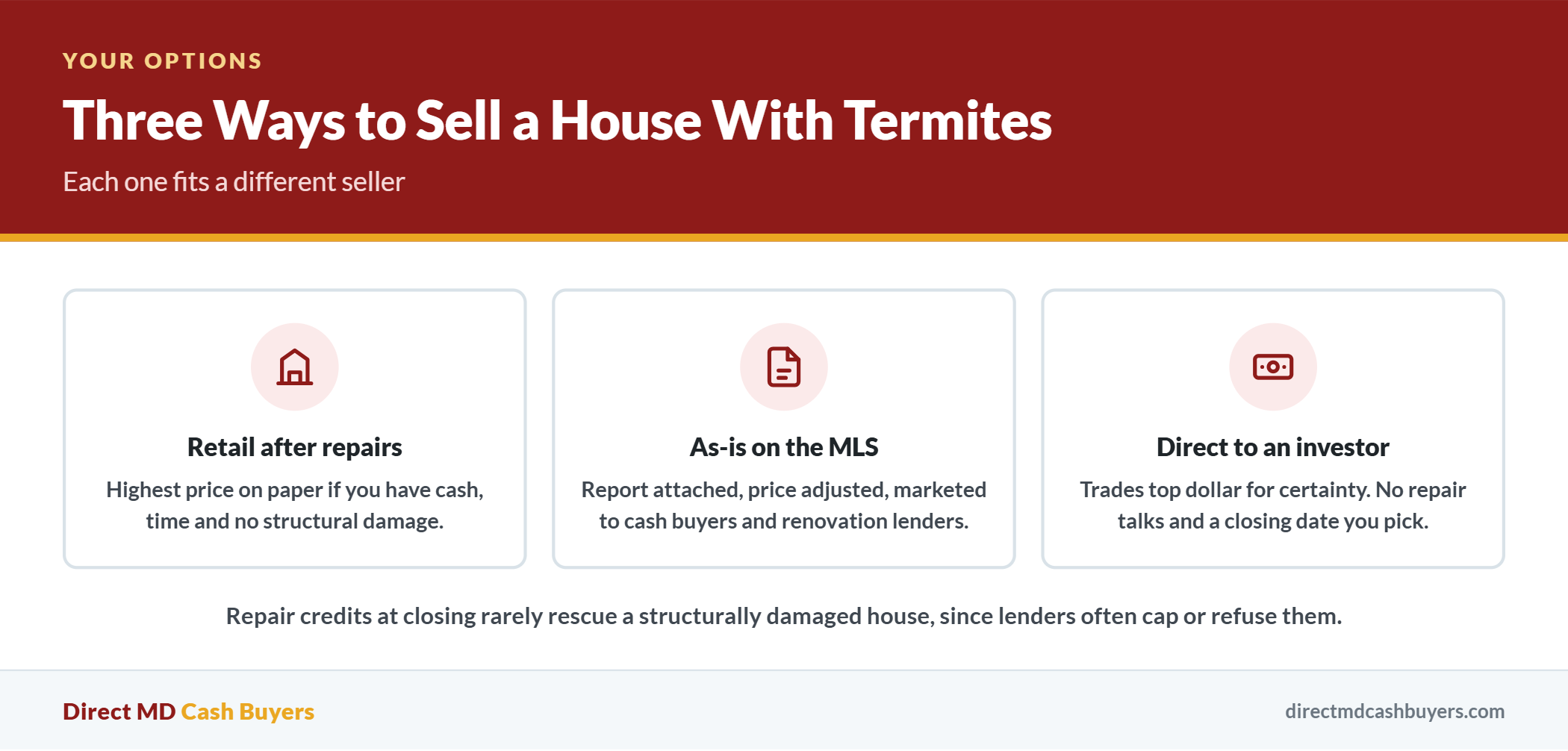
You’ve got three real paths, and each one fits a different seller.
List it retail after full treatment and repair. List it as-is with the pest report attached and the price adjusted. Or sell direct to an investor who buys the condition as it stands.
Retail with repairs gets you the top sale price when you have cash, time, and a house without structural damage. You’ll get appraisal-friendly financing, a full buyer pool, and the highest number on paper.
An as-is listing on the MLS is the middle road, and it’s underrated. Attach the report, price it honestly, and market to cash buyers and renovation lenders. You’ll lose financed buyers whose underwriters balk at active termites, but you’ll keep competitive bidding. Cash activity supports this route, since all-cash sales made up 29% of transactions in October 2026, up from 27% the prior month, according to HousingWire.
Direct sale to an investor trades top dollar for certainty. You skip the repair negotiation, the lender conditions, and the second inspection surprise. Here at Direct MD Cash Buyers, we price the property around its current condition, including whatever termites have done to the framing, and close on a date you pick. Sellers handling inherited properties, out-of-state ownership, or a tight payoff deadline usually land here.
One option gets oversold, and I’d push back on it. A repair credit at closing sounds clean, but lenders often cap credits or refuse to fund a house with an active infestation at all. Credits work for cosmetic issues. They rarely rescue a structurally compromised transaction.
Finding Buyers Willing to Purchase a Home with Termites
A seller I know listed a 1960s ranch house, lost two buyers to the pest report in six weeks, and dropped the price twice. She switched to marketing it directly to renovation investors and had the house under contract in nine days.
Your buyer pool narrows, but it doesn’t disappear. Who’s still in it? Investors and flippers who price repairs by the linear foot without flinching. Contractors buying their own next project. Renovation-loan buyers using 203(k) financing, which wraps the repair cost into the mortgage itself. Neighbors who want the lot, and landlords building a portfolio.
Presentation matters more here than in a normal sale. Hand buyers the inspection report, treatment estimates from two licensed pest control companies, and any photos from the crawl space. Investors pay more for a measured problem than for a vague one, because our risk reserve shrinks when we can see the scope.
Expect lowball offers. Some are honest condition-based pricing, while others test whether you’re desperate. A fair as-is offer should reflect retail value minus real repair costs minus a reasonable margin. It shouldn’t be retail minus a number pulled from the air, so ask any buyer to show you how they got there.
Local conditions matter more than national ones here. A buyer who has handled subterranean termites in your climate knows what a sill plate replacement really costs. A buyer who has only seen drywood damage in a dry state will overprice the risk. We underwrite these houses regularly at Direct MD Cash Buyers, and our number is usually tighter and easier to defend than what a national lead-buying operation offers.
Speed is the other variable. Financed buyers stack inspection periods, appraisal waits, and underwriting conditions on top of your timeline. Cash removes most of that.
What to Expect When You Accept an Offer on a Termite-damaged House
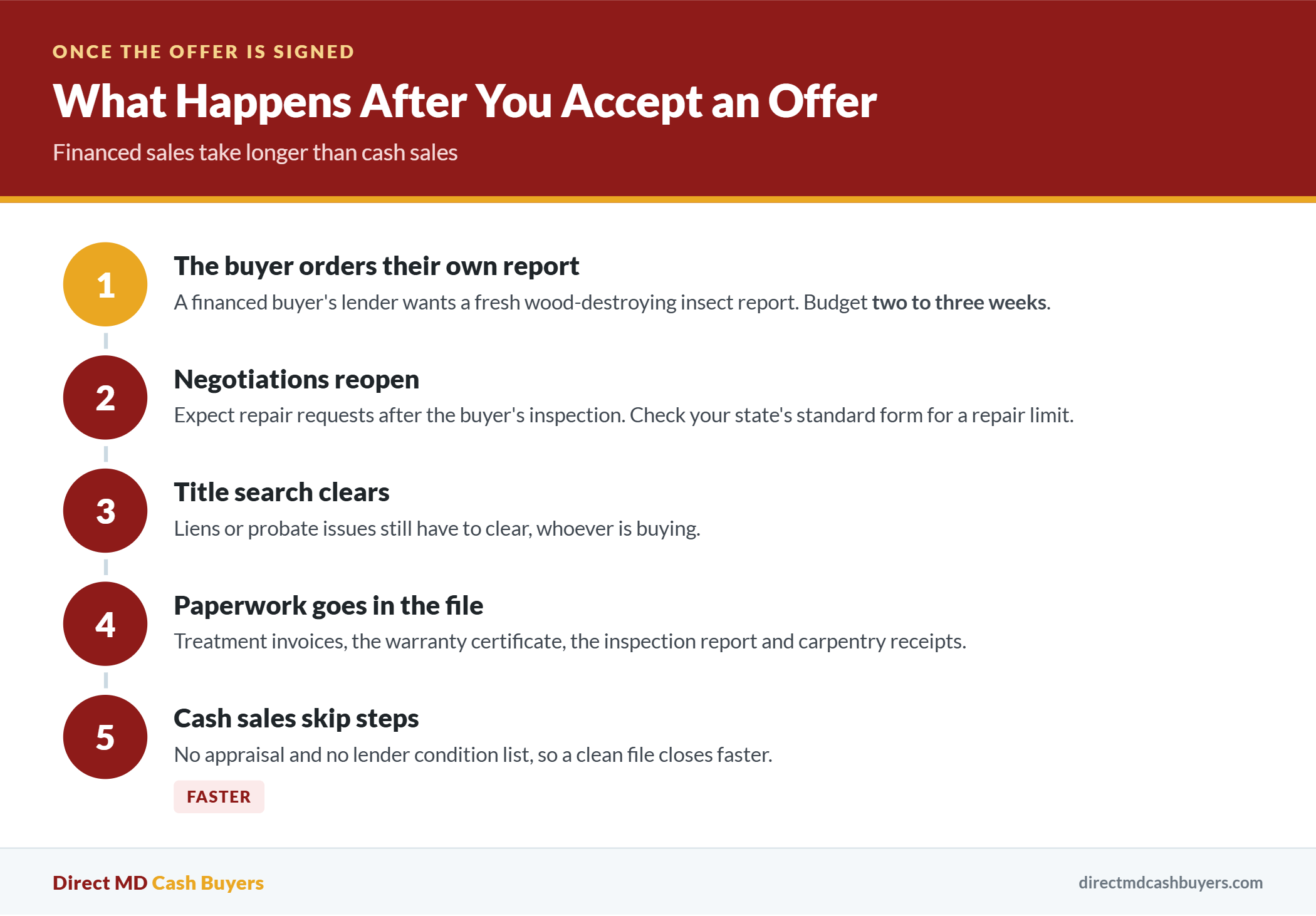
Once that offer is signed, the process looks different depending on who’s buying.
A financed buyer will order their own wood-destroying insect report regardless of what you’ve already provided, because their lender wants a clean form from a licensed operator. If your report is more than a few months old, expect a fresh one. Budget two to three weeks for that step alone.
Negotiations reopen after the buyer’s inspection in most retail transactions. That’s normal, not a failure. Some contracts cap what the seller has to spend on treatment and repair, and others leave it open. Read the wood-destroying insect terms in your contract and any addenda before you agree to anything open-ended.
Cash and investor buyers compress all of that. There’s no appraisal, no lender condition list, and no second round of repair demands if the buyer priced the condition right upfront. The title search still happens, and liens or probate issues still have to clear. A clean file closes faster than a complicated one no matter who’s buying.
Keep every piece of paper, from treatment invoices and the warranty certificate to the inspection report and carpentry receipts. Those documents go into the file at closing, and they’re your best defense if anyone questions what you knew.
Sellers who stay quiet about termites until the last week lose more money than sellers who lead with it. Disclosure early reads as honesty. Disclosure late reads as concealment, even when it isn’t.
A landlord called us after four straight months of chasing a tenant for rent on a duplex he’d inherited and never wanted. He found the termite tubes himself while hauling the tenant’s abandoned deep freezer out of the garage on a Saturday. I’ve seen that kind of discovery turn landlords into sellers overnight. He didn’t want a renovation project or another lease. He wanted the key out of his pocket, and we closed on the date he asked for.
If you’re sitting on a house with termites and the repair quotes are turning your stomach, you don’t have to decide today. Talk to a licensed pest company, get the scope in writing, and run the numbers both ways. If selling as-is looks like the better math, we’re happy to walk you through what a direct offer would look like on your property. No pressure, no obligation, and no hard feelings if you’d rather list it.
Frequently Asked Questions
Can Termites Be Bought or Sold as Part of a Property?
Nobody buys termites on purpose, but plenty of investors knowingly buy houses that have them. When you sell a property with an active infestation to a cash buyer, the problem transfers along with the deed, and the price reflects it. The insects themselves aren’t a commodity. The discounted house is.
Can You Sell Your House Without a Termite Bond or Warranty in Place?
Yes. A bond or warranty is a service contract with a pest control company, not a legal requirement for transferring ownership. Some buyers will ask for one as a condition of their offer, and a transferable warranty makes your house easier to sell. Plenty of properties still change hands without either. If you have one, find out whether it transfers and tell your buyer.
How Long Until Termites Destroy a House?
Structural failure takes years, not months, and the timeline depends on species, moisture, and how much wood the colony can reach. Subterranean colonies working a damp crawl space do more damage faster than drywood activity in an attic. Waiting is still the expensive choice, since the repair figures quoted earlier climb steeply once joists and sill plates get involved.
How Much Is a Termite Treatment for a 2000 Sq Ft House?
For a home that size, treatment lands in the low thousands for a liquid barrier or bait system. Tent fumigation costs more because it’s priced by the cubic volume of the house. The exact number depends on your foundation type, the perimeter footage, and the species involved. Get two written quotes from licensed pest control companies, since the spread between them is often wider than sellers expect.
Will Homeowner’s Insurance Cover Any of This?
Almost certainly not. Standard policies treat wood-destroying insect damage as preventable maintenance rather than a covered peril, so treatment and repair come out of your pocket. Read your own policy, and don’t build a selling plan around a claim being paid.
Termites and the Maryland Market
Maryland’s median sale price reached $445,000 in August 2026, according to Maryland REALTORS, while the number of homes sold fell 8.5% from a year earlier. With fewer buyers around, a pest report can stall a retail listing for weeks.
Direct MD Cash Buyers can buy your Maryland house with the termite damage still in place.
That includes houses in and around Baltimore that need more work than you want to take on. We’re also cash home buyers in Towson and the nearby Baltimore County suburbs.
Get an As-Is Offer on Your House
If the repair quotes don’t make sense, you don’t have to fix anything before you talk to us. Share what the pest report found and when you’d like to move, and we’ll put together a cash offer for the house as it sits today.
Contact Direct MD Cash Buyers or use the form below. There’s no cost to ask and no obligation to accept.