

A title search is cheap and usually comes back within a few days, so skipping it never makes sense. That one search tells you whether somebody filed a lawsuit against your property while you were busy living your life. Maybe a lis pendens is sitting on your title right now. You can still sell. This sale just looks different than you pictured.
What Is a Lis Pendens and How Does It Affect a Property Sale?
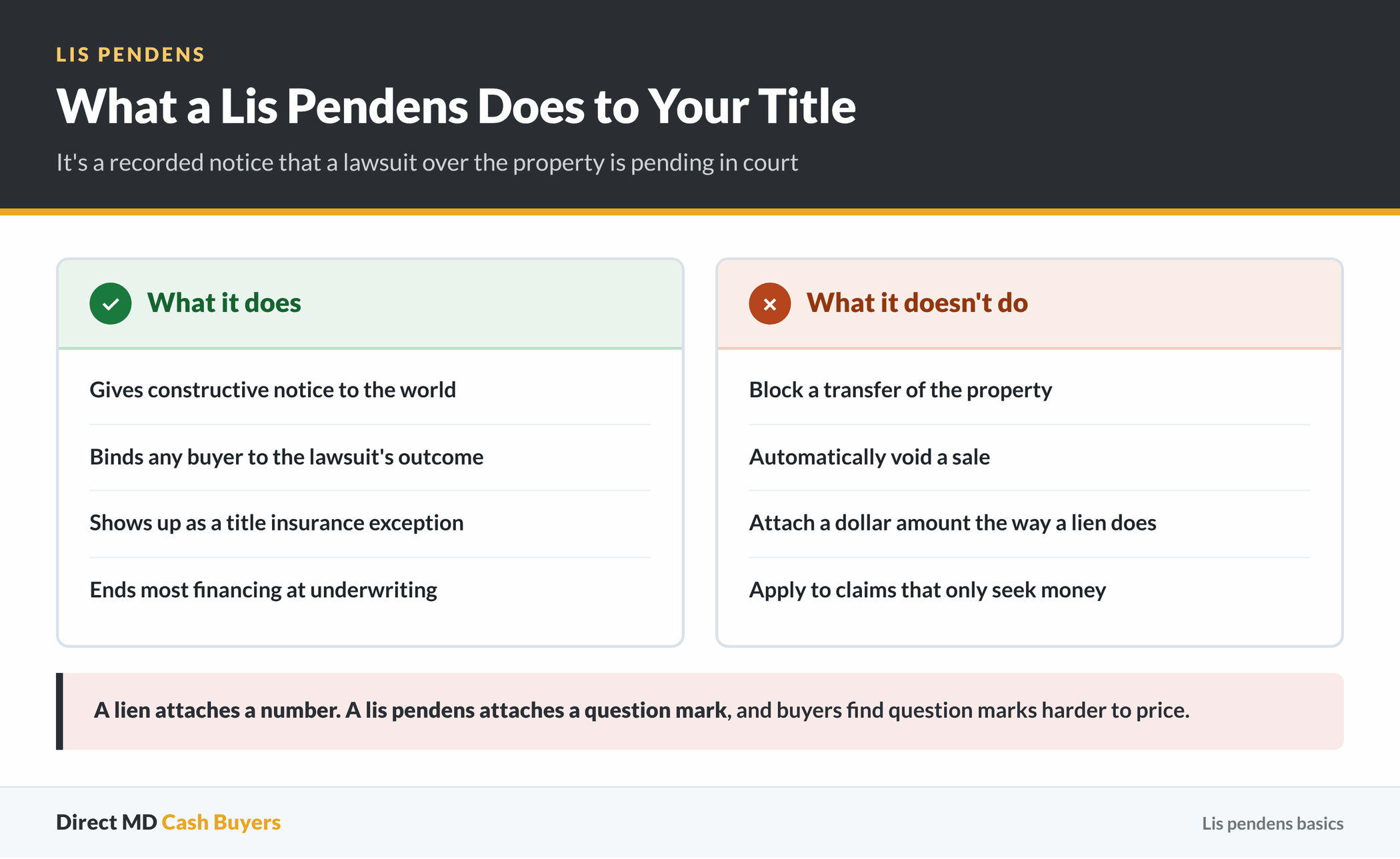
You might figure this is paperwork, a clerical thing your attorney can wave away with one phone call. It isn’t. A lis pendens is a recorded notice telling the world that a lawsuit touching this specific real property is pending in court. Once that notice is recorded against a piece of property, any would-be owner or lender sees that the title is in question. That alone makes the property harder to sell or finance.
The phrase is Latin for “suit pending.” Its legal effect is constructive notice. Anybody who buys after the filing takes the property subject to whatever the court eventually decides. It does not block a transfer or automatically void one. It simply binds whoever buys to the outcome of the litigation. What it does block is your ability to hand a buyer clean title.
So where does the pain actually land? Title insurance. A title company reviewing your property will flag it as an exception, and the title policy won’t insure against losses tied to that lawsuit. Lenders don’t fund a mortgage on an uninsured title. The retail buyer’s financing usually dies right there in underwriting, after they’ve already paid for an appraisal and an inspection.
The rules shift based on where the property sits, and for a Maryland house the one that counts is Maryland Rule 12-102. It covers lawsuits in a Maryland circuit court or the federal court in Maryland that affect title to, or a lease on, Maryland real estate. The Maryland Judiciary publishes the Notice of Lis Pendens form that filers use under it. Other states run their own statutes with different deadlines, so the Maryland rule is the one your attorney and title company will work from.
One common mix-up needs correcting: it’s not a lien. Liens attach a dollar amount to your property. A lis pendens attaches a question mark instead, and buyers have a much harder time pricing a question mark than a number.
How Does a Lis Pendens End Up on Your Title?
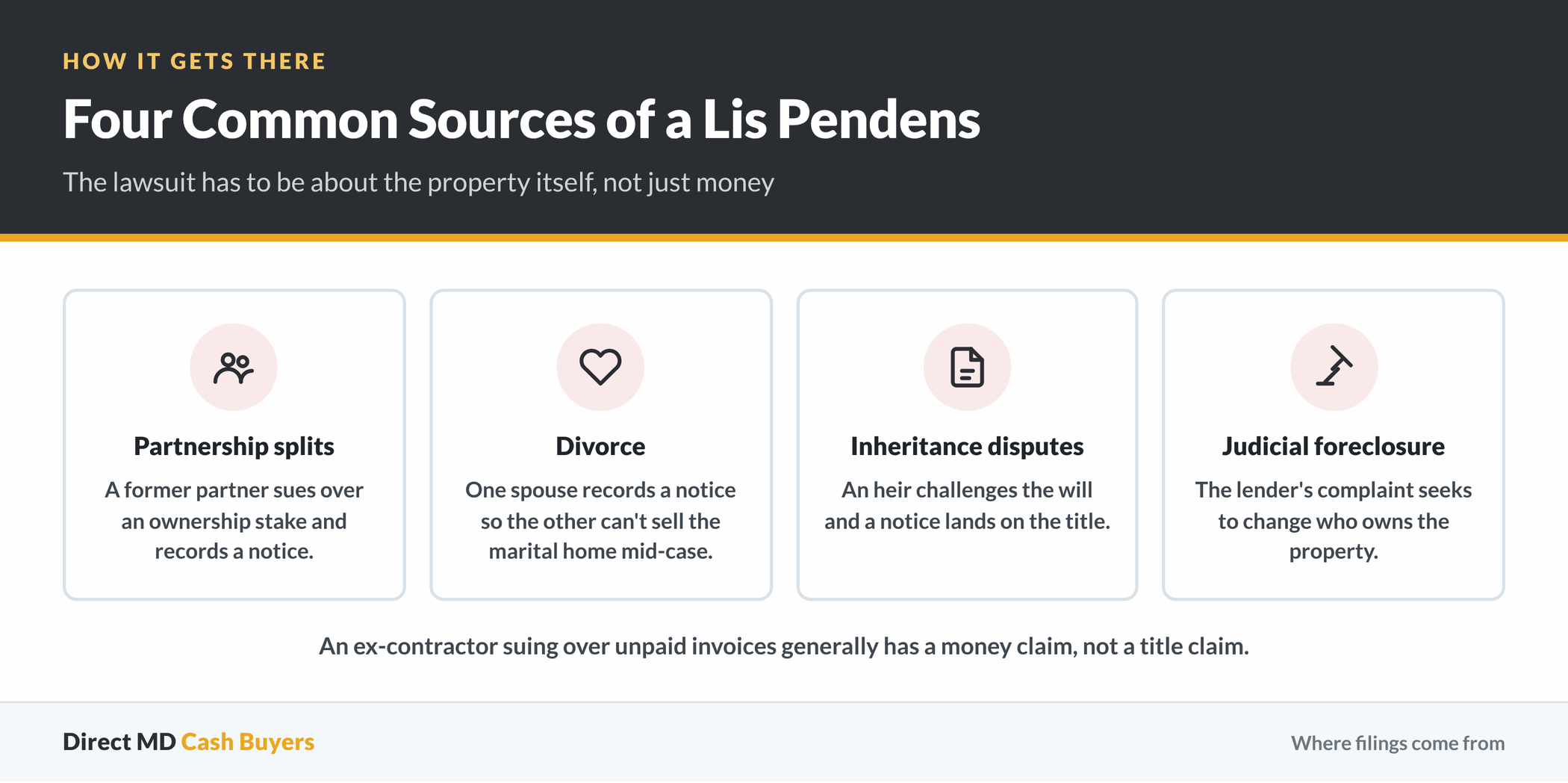
A landlord in Baltimore called us early last year, worn down after carrying two mortgages for eleven straight months. His former business partner had sued over an ownership stake in the rental. The partner filed a notice against the title, then let the case crawl. His story is a common one. A fight between two people ends up recorded against the house itself.
Partnership splits produce a lot of these. So do divorces, where one spouse records a notice to keep the other from selling the marital home in the middle of the proceedings.
Inheritances are another source. One heir sells, a second heir claims the will was wrong, and a notice of pending legal action lands on the title before the ink dries on the listing agreement.
Your claimant can also be your lender. In judicial states, foreclosure complaints routinely come paired with a recorded notice, since that lawsuit directly seeks to change who owns the real estate.
There’s a limit that trips up a lot of claimants, though: the lawsuit has to genuinely be about the property. A real property claim is one that would change someone’s title or right to possession if the claimant wins. A claim that only seeks money doesn’t qualify, even when the dispute has some tie to real estate. Your ex-contractor suing over unpaid invoices usually has a money claim. That isn’t a title claim.
The claimant doesn’t need a judge’s permission first. In Maryland, the claimant records a certified copy of the complaint or a Notice of Lis Pendens in the county land records. That can happen the same week the suit is filed. Recording offices will take that filing from anyone who claims entitlement to file one.
That ease of filing is why courts built removal machinery, covered further down.
What Happens to Your Sale Once a Lis Pendens Is Recorded?
Your listing can stay active the entire time. What dies quietly is the pool of buyers who can get a loan.
Cash buyers can stay. Everybody else walks, and in a market full of mortgage-dependent buyers, that’s most of your traffic.
Time makes the squeeze worse, because homes just sit longer now. Homes sat on the market for a median of 35 days in October 2026, up from 33 days the prior month, according to National Association of Realtors data released in November. Add thirty to forty-five days for a conventional closing. Now you’re past the two-month mark on a clean sale, and litigation runs on a slower clock than that.
Money shifts too. Redfin reported that the median U.S. home sale price slipped 0.4 percent year over year to $388,634 in October 2026, the first annual decline since May 2023. Soft prices and a clouded title don’t produce bidding wars.
Your escrow officer will order the title commitment, spot the filing, and issue the exception. At that point most buyers close the file and take their deposit back.
Some sellers hope the buyer won’t notice until closing. That never works. Title searches catch recorded notices every single time, and a buyer who finds out late tends to walk away angry instead of negotiating.
Tell them in week one. You’ll lose the buyers who were always going to leave, and you’ll keep the ones who can actually close.
Can a Lis Pendens Be Removed or Challenged Before Closing?
We once met a seller whose former tenant had recorded a notice claiming an unwritten option to buy. Notices like that are exactly what a removal motion is built for.
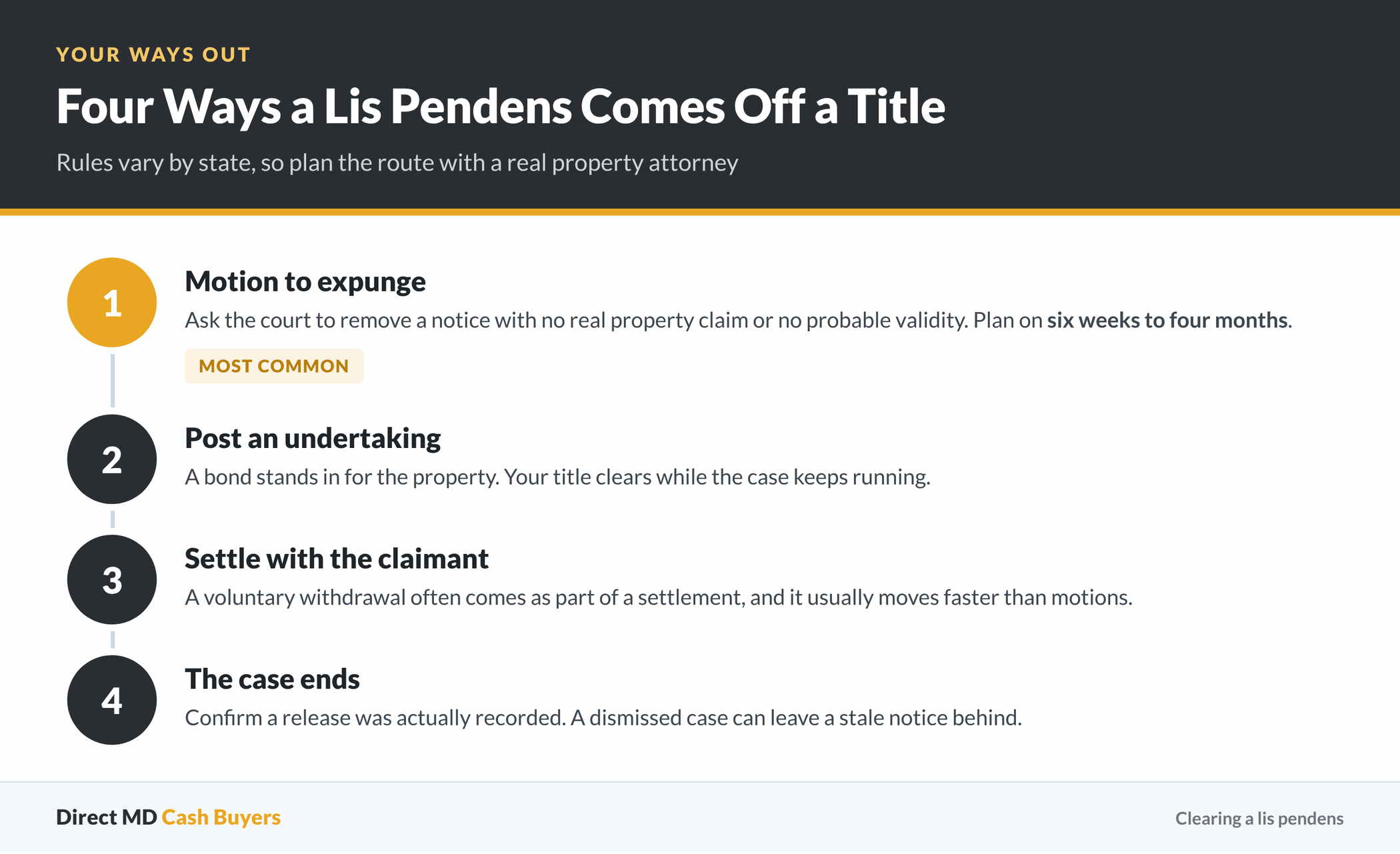
In Maryland, the tool is a motion under Maryland Rule 12-102(c). Any person with an interest in the property can ask the court to terminate the lis pendens for good cause while the case is still pending.
A good cause argument often starts with the claim itself. Maryland courts apply the doctrine only to lawsuits that directly involve the property, so a money-only claim gives you a strong reason to ask. A termination order covers the county where the case sits and any other county where the notice was recorded.
The lis pendens also ends on its own in some outcomes. A dismissal that isn’t appealed ends it, and so does a judgment for the defendant that stands. Once it ends, the plaintiff has to record a notice of termination in each county’s land records.
A baseless claim of this kind can expose the recording party to attorney fee awards, sanctions, and slander of title liability.
The claimant can also withdraw the notice voluntarily, often as part of a settlement. Or the case can simply end.
Motions to expunge are won on statutory grounds and local practice, and a general practitioner will burn your money learning the procedure. How long does it take? That depends on the court’s calendar and how hard the other side fights, so ask your attorney for a local estimate.
Is a Lis Pendens Bond Ever Required to Clear a Title?
If we were sitting at your kitchen table, this is the question we’d want you asking: can I pay my way out of this and move on? In Maryland, the short answer is usually no, at least not through a set bond procedure.
Some states let an owner post a bond and swap money for the property while the case runs. Maryland Rule 12-102 doesn’t include that step. Under the rule, a lis pendens ends through a court order for good cause, a dismissal, or a judgment for the defendant.
Don’t confuse this with a mechanic’s lien. Maryland does let an owner bond off a contractor’s lien, but that’s a separate statute for a different kind of claim.
Money can still help, just in a different way. A claimant who’s really after cash may agree to release the notice in exchange for a payment or a share of the sale proceeds held in escrow. That’s a settlement, so get it in writing and make sure the termination notice gets recorded.
Before you count on any of this, ask your attorney what the court in your county is likely to treat as good cause. That answer shapes whether a motion, a settlement, or a cash sale gets you out fastest.
Why Do Most Buyers Walk Away From a House With a Lis Pendens?
Plenty of buyers figure a discount makes any title problem worth it. Fifteen percent off a house feels like real money. Then the court rules against the seller, and that buyer is stuck in a case they never agreed to join.
Buyers who close over an active lis pendens take the property subject to the judgment. Losing the case can mean losing the house, or at minimum whatever interest the court awards the claimant. No title policy covers it, because the exception was disclosed before closing.
Experienced investors price that risk. They read the complaint and run the odds with counsel before they write an offer.
Maryland’s rule doesn’t put a fixed expiration date on the notice. It stays in place until the case ends or a court terminates it, so a buyer can’t simply wait it out.
Any buyer who needs a mortgage, an HOA-approved condo loan, or a renovation loan will get turned down at underwriting. Institutional creditors won’t lend against real property they can’t foreclose cleanly.
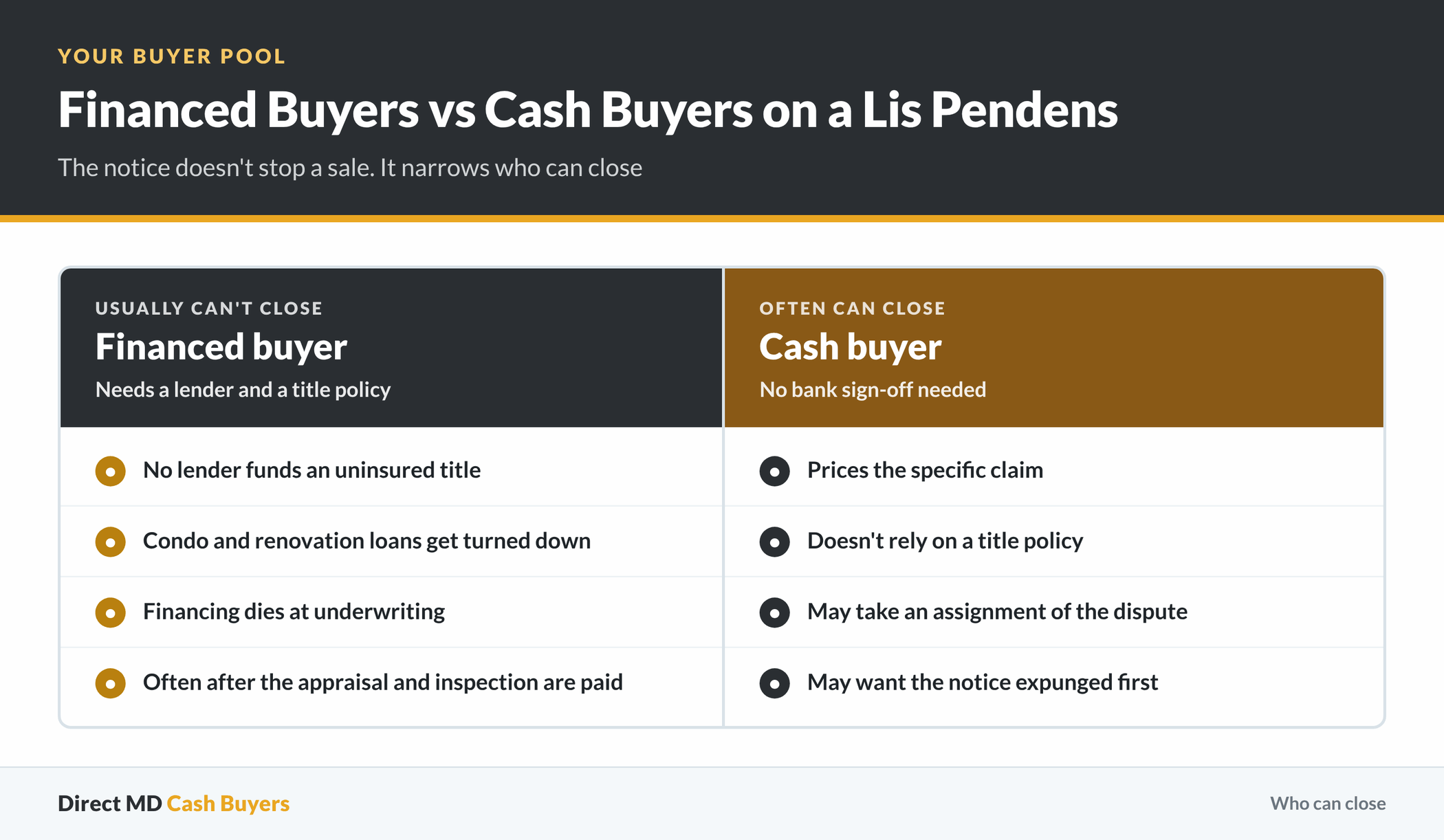
That gap is where selling to an established cash buyer solves a problem retail marketing can’t. Companies like Direct MD Cash Buyers evaluate a property with a lis pendens on its own terms. They aren’t asking a bank for permission, and they aren’t relying on a title policy that excludes the exception.
A landlord in Hagerstown inherited his mother’s house with thirty years of belongings still inside, right down to a chest of sewing patterns in the hall closet. He also had three siblings who wanted their share by Thanksgiving. Clearing the lis pendens first and then selling as-is got everyone paid without anybody renting a dumpster.
What Questions Do Sellers Usually Ask About a Lis Pendens?
Guess wrong here and you’ll sign a listing agreement, pay for staging and photos, then spend ninety days learning what a title search would have told you on day two. Order the title report before you do anything else.
The questions below come up in nearly every conversation we have with a seller in this spot. Answers vary by state. Treat them as a starting point for a talk with a real property attorney in your jurisdiction, not as legal advice.
One more practical note before the FAQ. Sometimes the dispute is between family members or former partners who all want the same thing (cash in hand, matter closed). When everyone wants the same outcome, settlement almost always moves faster than motion practice, and siblings who agree can be done in a month.
Frequently Asked Questions
What Is the Actual Purpose of Filing a Lis Pendens on Real Estate?
A claimant files one to put the world on notice that a lawsuit over this real property is pending. Nobody can later claim they bought without knowing. It also freezes the practical value of the property while the case runs, since financing and title insurance both dry up. Courts allow it because a plaintiff with a legitimate claim to ownership shouldn’t lose that claim just because the defendant sold the house mid-case.
How Long Does a Lis Pendens Last?
In Maryland, there’s no set expiration date. The notice stays on the land records until the case ends or a court terminates it for good cause. After that, Maryland Rule 12-102 requires the plaintiff to record a notice of termination in each county where the notice was filed. Don’t assume a quiet case means a clear title.
Can I Still Sell My House While a Lis Pendens Is Recorded?
Legally, yes. You hold ownership and you can convey the property. The practical catch is that whoever buys steps into the lawsuit’s outcome, so mortgage lenders and most retail buyers won’t touch it. Your realistic market shrinks to cash buyers who understand the risk and price for it.
Will a Lis Pendens Show Up in a Standard Title Search?
Every time. It’s recorded in the county where the real property sits, so it shows up on the title commitment next to liens, easements, and HOA assessments. Hiding it isn’t an option. Sellers who try often end up in a second lawsuit on top of the first one.
Who Pays the Attorney Fees to Remove a Lis Pendens?
You front your own costs to bring the motion. Maryland’s rule does give you one lever on fees. If the lis pendens ends and the plaintiff doesn’t record a notice of termination within 10 days, the court can let you record it instead. The court can also order the plaintiff to pay the costs, including reasonable attorney’s fees, unless the plaintiff had a good reason. Ask your attorney whether any other fee provision fits your case.
Does the Lis Pendens Disappear Automatically When the Lawsuit Ends?
In Maryland, the lis pendens itself ends when the case is dismissed without a timely appeal or decided for the defendant. The record doesn’t clean itself up, though. The plaintiff has to record a notice of termination in the land records, and until that happens the old notice can still cloud your title. Have your title company confirm the termination was actually recorded, not just that the case docket shows closed.
Is Selling to a Cash Buyer a Realistic Option with Litigation Pending?
Often it’s the only option that closes on a timeline you can live with. A buyer paying cash isn’t waiting on an underwriter who needs a clean title policy. The sale turns on whether that buyer is comfortable with the specific claim and how it’s documented. Some will take an assignment of the dispute, and some will want the notice expunged first. The honest ones will tell you which camp they’re in on the first call.
What a Lis Pendens Means for Maryland Sellers
We buy houses across Maryland, and a lis pendens doesn’t take a house off our list. Maryland REALTORS put the statewide median sale price at $445,000 in August 2026, up 2.3% from a year earlier. That’s a lot of equity to leave frozen while a court calendar crawls along. We look at a house with title problems the same way we look at any other house.
Talk Through Your Lis Pendens With Us
Maybe you’re carrying a house with a lis pendens on it, and the monthly bills aren’t waiting for a court calendar. We’re happy to talk it through with you. Bring your title report and we’ll tell you plainly what we see. That might point toward a motion to expunge, a settlement with the claimant, or an offer from us at Direct MD Cash Buyers. There’s no pressure and no obligation, and no hard feelings if you decide to wait the litigation out.
You don’t need the lawsuit resolved to ask a question. Send us what’s on your title report, and we’ll tell you what we see and what your choices look like from here. When you’re ready, contact Direct MD Cash Buyers whenever it suits you.
Helpful Maryland Blog Articles
- How Soon Can You Sell Your House After Chapter 7 Bankruptcy
- How Maryland Homeowners Can Sell a House with Septic Tank Problems
- Selling a Fire-Damaged House in Maryland
- Can Medical Bills Take Your House in Maryland?
- How to Get Rid of an Unsellable House
- How to Take Your House Off the Market in Maryland
- How to Find a Realtor in Another State
- Cheapest Places to Live in Maryland
- How to Sell a Maryland House with a Wet Crawl Space
- Can You Sell a House with a Lis Pendens on the Title
- Can I Sell My House With a Pending Insurance Claim
- Cost to List on MLS in Maryland