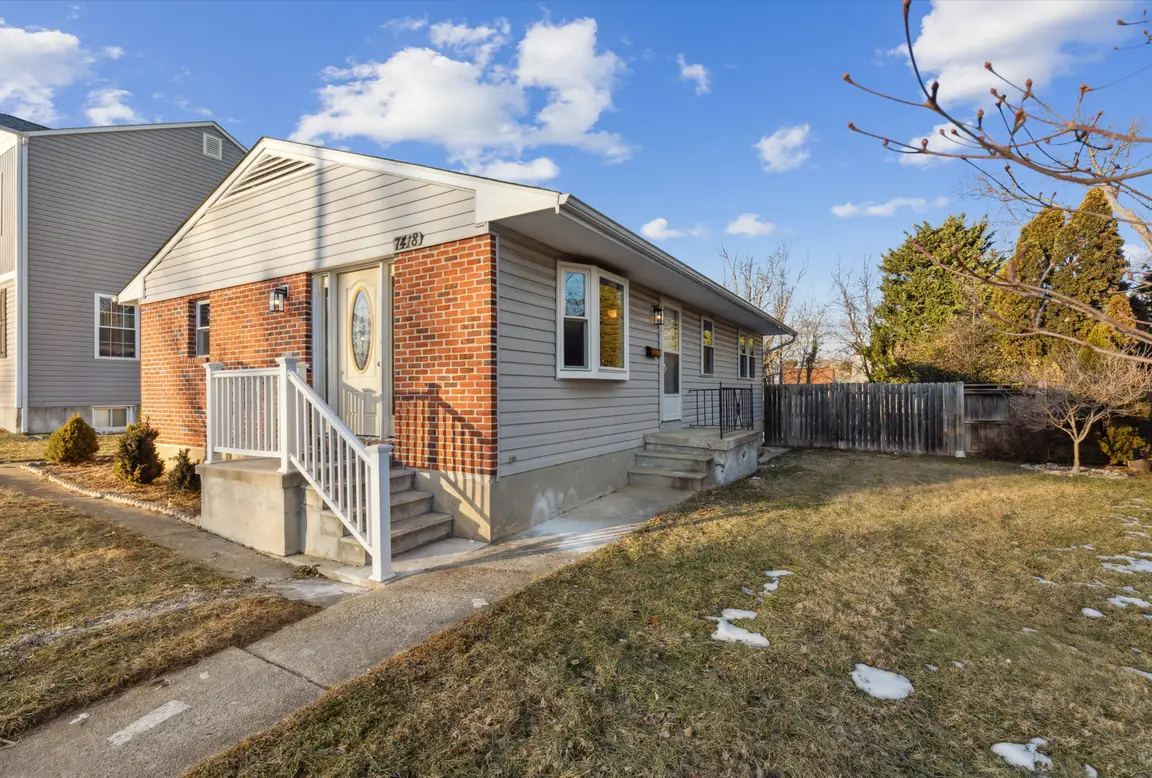


Pull back the hatch door on an older Maryland rancher after a week of rain, and you might find an inch of standing water sitting on bare dirt. It happens in Dundalk, and it happens in Hagerstown just as often. The second you see it, your brain jumps to the number. What’s this going to cost me, and can I still sell? A wet crawl space can feel like the end of your sale. After buying houses across this state for years, I can tell you it’s one of the most common conditions we run into. Knowing your real options matters far more than panicking about the water.
Why Maryland Crawl Spaces End Up with Water
“Did I do something wrong?” Probably not, since our soils and our weather do most of the damage on their own.
Maryland sits in a mixed-humid climate zone. The Piedmont counties have heavy clay, and the ground closer to the Bay is sandy with a high water table. Clay holds rain against your foundation instead of letting it drain away, while sandy soil lets groundwater rise fast. Neither is kind to a vented crawl space. One contractor cost study found that a typical vented Maryland foundation space starts showing real moisture damage in roughly 12 to 18 years, versus 20 to 30 years in drier states.
Grading causes more of this than any single pipe. Soil settles over the decades and the ground tips back toward the house. After that, every storm sends water straight at the foundation wall.
The rest of the usual suspects are familiar. Downspouts dump right at the corner, a sump pump fails, a slow supply line leak drips for months, or a missing or torn vapor barrier lets soil moisture evaporate upward. Summer humidity makes it worse. Picture 85-degree outdoor air rolling through open vents into a 62-degree space below the house. It condenses on the ductwork and the joists, and the water you’re seeing never came from rain at all.

One family found the crawl space hatch behind a stack of lawn chairs in the garage. They opened it on a Saturday morning and discovered water had been pooling under the back bedrooms for who knows how long.
I keep seeing that pattern. Nobody walks through a crawl space, so problems stay invisible until somebody needs to sell.
What Standing Water Does to Your Maryland Home
Once the water sits, it goes to work on the wood. Floor joists and the subfloor soak up moisture until the wood softens. In bad cases you get a bouncy spot in the hallway, and every Maryland home inspector knows how to find it with one heel.
Mold growth needs about 60 percent relative humidity to take hold. A wet one in a Maryland July runs well past that. Air moves upward through a house, so whatever’s growing below your floors ends up in the air you breathe in the living room. Notice a musty smell in the hall closet? That’s often it talking.
Termites and carpenter ants love damp wood too. Maryland’s eastern subterranean termite is already everywhere, and a wet crawl space is basically an invitation with a return address on it. If they’ve already moved in, here’s how to sell a house with termites without sinking money into repairs first.
Ductwork rusts. Insulation falls off the joists in soggy clumps, and your HVAC system works harder pushing conditioned air through a damp, cold space.
Sellers tend to underestimate one thing: the damage compounds by category, not by inches of water. An inch of water that’s been there two months is a vapor barrier problem. An inch that’s been there six years can mean sistered joists, a replaced subfloor, and a mold assessment.
I’d much rather a seller find this early than have a buyer’s inspector find it on day nine of a contract. Early discovery gives you choices. Discovery during an inspection contingency hands you a negotiation where you’ve already lost the high ground.
How Much Does Crawl Space Water Repair Cost in Maryland?
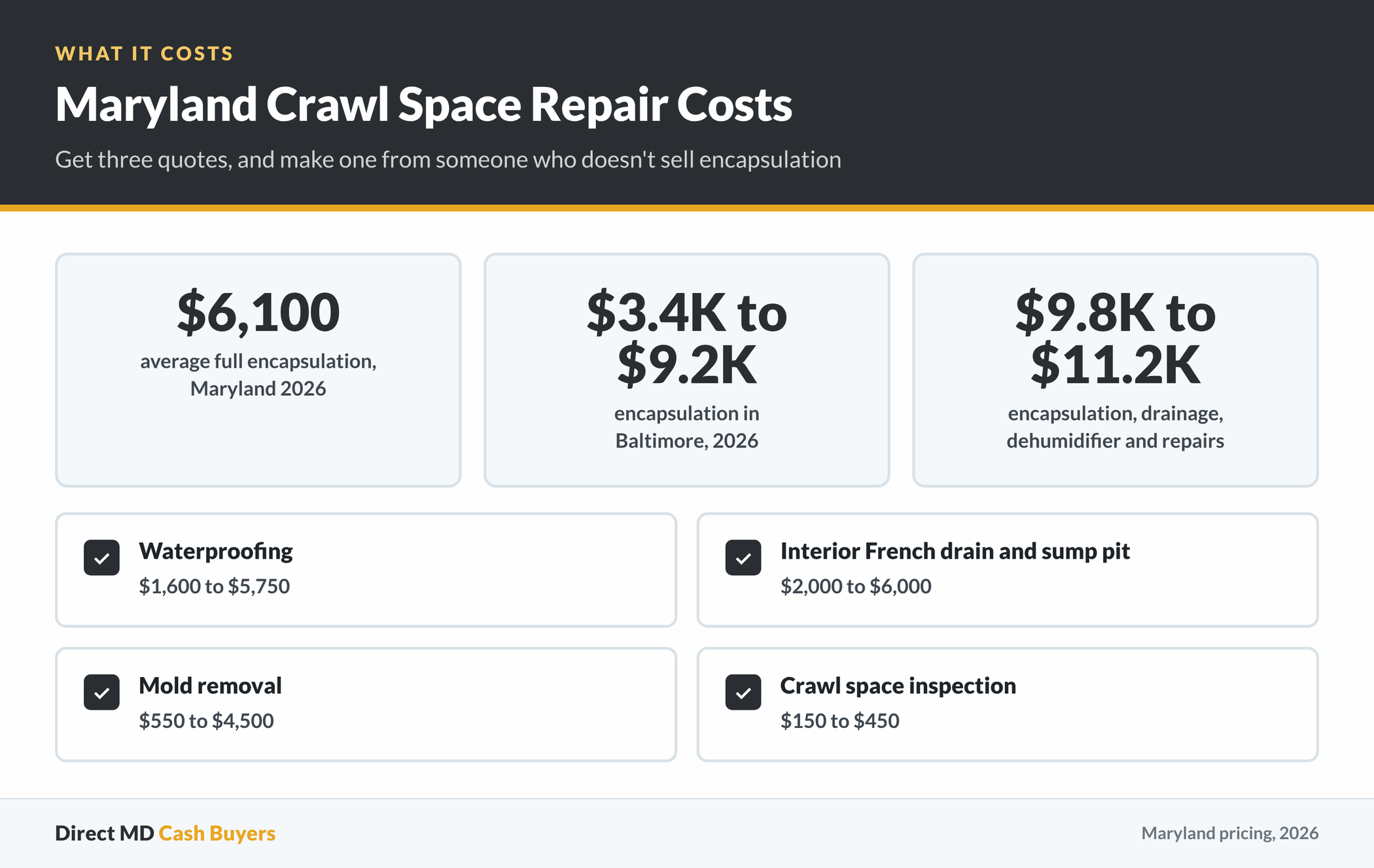
Nobody’s crawl space quote ever comes in at the number they first heard. One statewide cost database put full encapsulation in Maryland at an average of around $6,100 in 2026, with per-square-foot pricing running roughly $3.30 to $8.80.
Baltimore-area pricing tells the story better. Local estimates put encapsulation in Baltimore between $3,400 and $9,200 in 2026. Waterproofing work lands between $1,600 and $5,750, and mold removal runs anywhere from $550 to $4,500. Next to all that, an inspection at $150 to $450 almost feels like the cheap part.
Montgomery and Howard County homeowners generally pay the DC-corridor premium on labor. Permits for a conditioned crawl space with a dehumidifier cost more in that corridor than out in Garrett or Allegany County.
Drainage work is where budgets break. An interior French drain tied to a sump pit typically lands in the $2,000 to $6,000 range, and that’s before anyone touches rotted wood.
So what does a full job look like on a Maryland house with actual water damage? Think encapsulation, drainage, a commercial dehumidifier and structural repairs, all together. Several Maryland case studies from a regional contractor landed around $9,800 to $11,200 for that combination. Treat those numbers as floors once joist replacement enters the picture. I’ve seen it push a job well past that range.
I give every seller one caution: get three quotes, and make at least one of them from a company that doesn’t sell encapsulation. Waterproofing contractors have a product to move. A structural engineer or an independent home inspector will tell you whether you need a $12,000 system or a $900 regrade with two downspout extensions.
What Does Fixing a Wet Crawl Space Involve?
“Can’t I just throw down some plastic and call it done?” People ask me that a lot, and now and then the answer’s yes. If your soil is dry, your grading is decent, and your only issue is evaporating ground moisture, a proper vapor barrier might solve it.
Water that actively gets into the crawl space is a different animal. Plastic over standing water just makes a swimming pool with a lid.
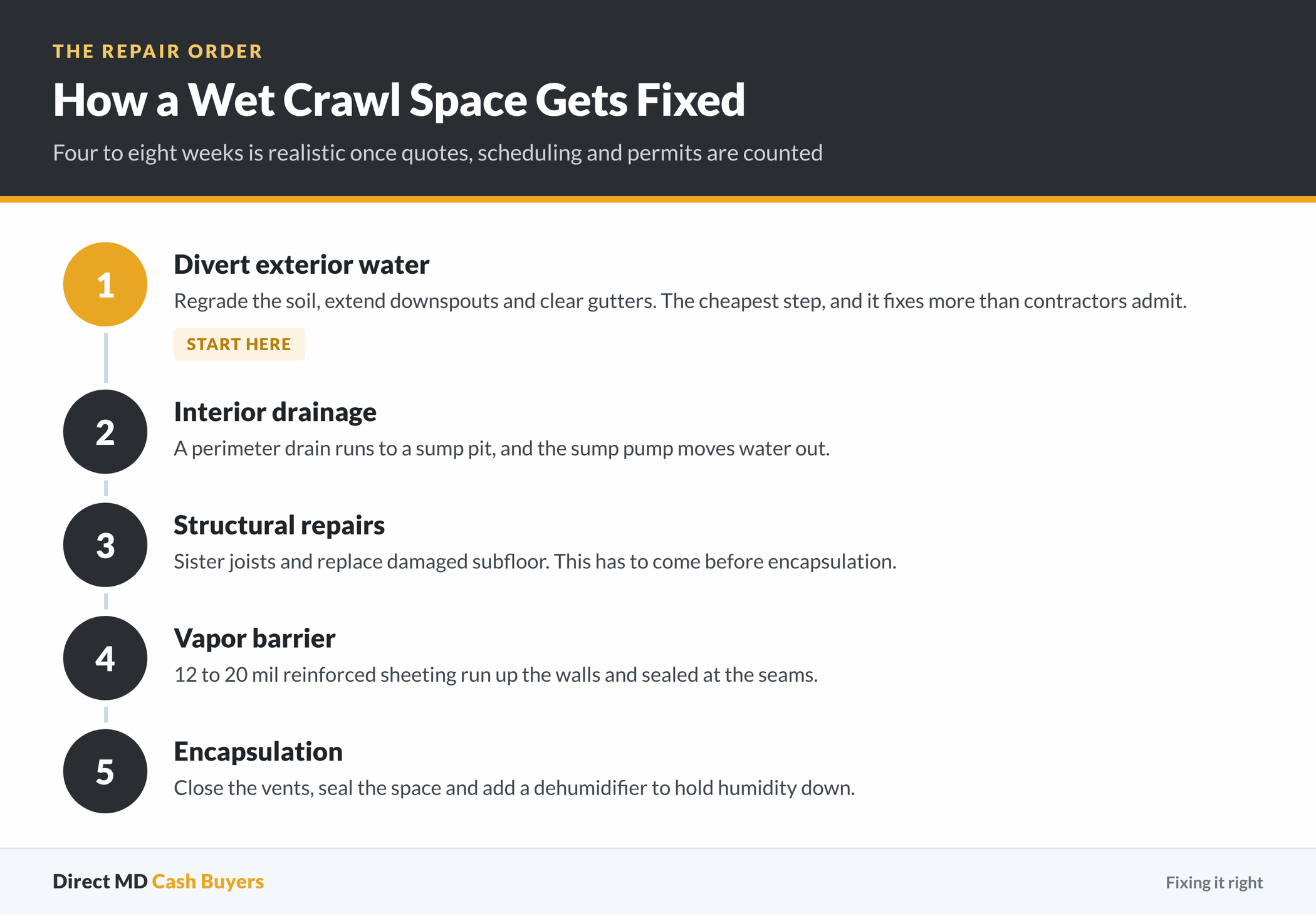
Doing it right means following a sequence. Exterior water gets diverted first. That means regrading the soil so it slopes away, running downspouts well past the foundation, and clearing gutters. It’s the cheapest work, and it fixes more Maryland crawl spaces than contractors like to admit.
If water still arrives, interior drainage comes next. A perimeter drain channels it to a sump pit, and the sump pump moves it out. After that comes the vapor barrier, usually 12 to 20 mil reinforced sheeting run up the foundation walls and sealed at the seams.
Encapsulation closes the vents, seals the space, and adds a dehumidifier to keep humidity in a safe range. Done right, your crawl space becomes a semi-conditioned part of the house rather than a dirt cave under your floors.
Structural repairs run on their own schedule. Sistering joists, replacing subfloor sections, treating or removing mold-damaged wood: that work has to come before encapsulation. In practice you’re juggling two contractors and two timelines.
How long does it all take? Four to eight weeks is realistic once you count quotes, scheduling, permits in places like Anne Arundel County, and the inevitable discovery of something worse behind the insulation.
What to Have Ready Before You Call a Crawl Space Pro
A company sends someone out, you get an estimate, and you pick a contractor. Then a second quote arrives at twice the number. Neither estimate describes the same scope, since you never gave both companies the same information.
One folder fixes most of that. Keep dated photos of the standing water. Add pictures of the joists, the vapor barrier, and the sump pit if you have one. Jot down what happened when. Did water show up after hurricane season, after a plumbing repair, or has it been there since you bought the house?
Measure more carefully than you’d think. Square footage of the crawl space, ceiling height, and how you get in all drive pricing. A pro crawling through a 24-inch hatch charges more than one working in a space with a full door.
Pull your paperwork too, including prior inspection reports, any waterproofing warranty from a previous owner, and receipts from past work. In Maryland, a transferable warranty from an earlier drainage job is worth real money at the closing table.
Your Maryland seller disclosure obligations start here as well. Under Section 10-702 of the Real Property Article, you’ll give a buyer either a Residential Property Disclosure Statement or a Disclaimer Statement. Even if you sell as-is with the disclaimer, you still must disclose latent defects you actually know about. Write things down as you learn them.
Ever tried to recall, months later, exactly what a contractor told you in a crawl space while you held the flashlight? Notes save you.
Can You Sell a Maryland House with a Wet Crawl Space?
Sarah in Baltimore County found standing water under her late mother’s house and was sure the sale was doomed. In October 2026, 4,785 homes sold across Maryland, and plenty of them had moisture problems below the floor. Yes, you can sell. One path just costs you less than the other.
This fall the Maryland market has shifted against sellers. The statewide median sale price slipped 1.7 percent to $430,000 in October 2026, and sales fell 16.5 percent year over year, according to Bright MLS data compiled by Maryland REALTORS. Active inventory jumped nearly 23 percent to over 19,000 homes.
A house with a known crawl space issue competes against four dry ones on the same street.
You’ve got three real paths. Repair first and list, disclose and list at a discounted price, or sell as-is to a buyer who handles the repair. Each one works for a different seller.
Howard County and parts of Anne Arundel still reward turnkey condition.
Disclosing and discounting works when the repair cost is predictable. Buyers will price in a known $7,000 fix. An unknown problem gets priced at three times that, because fear always costs more than facts.
Selling as-is to a cash buyer skips the repair entirely. Direct MD Cash Buyers buys Maryland houses with wet crawl spaces regularly. The water underneath doesn’t decide whether an offer happens, only what the number is. Nobody’s asking you to fix anything first.
Does Crawl Space Water Scare Off Financed Buyers?
A Severna Park seller had a ratified contract at full asking price. Nine days later, the buyer’s FHA appraiser crawled under the house and flagged visible moisture and deteriorated joists. The whole thing unwound.
FHA and VA appraisers look for structural soundness and health hazards. Standing water, visible mold growth and soft wood add up to a repair requirement, and the loan won’t fund until someone addresses it.
Conventional lenders are looser, though they aren’t blind. If an appraiser notes “evidence of water intrusion,” the lender asks for an evaluation and your timeline stretches.
Maryland’s selling clock already runs longer than it did. Comparing October 2025 to October 2026, median days on market statewide rose from 17 to 21 days. Eastern Shore properties took 27 days last October, against 19 the year before. Add 30 to 45 days of closing time, then a failed inspection and a relist, and your summer listing turns into a fall listing.
When a sale falls apart, the listing goes back on the market carrying days-on-market baggage. The next round of buyers assumes something’s badly wrong.
Cash buyers remove the appraiser from the equation altogether. There’s no lender, no repair escrow, and no underwriter reviewing a mold inspection report.
So which risk would you rather carry? It’s either the cost of fixing the crawl space or the chance a financed sale collapses after you’ve already moved out.
Should You Sell the House as Is with Water Below It?
If the repair bill approaches what you’d gain in sale price, you’re working for free. I lay out that math at kitchen tables across Maryland, and it ends a lot of agonizing in about five minutes.
Run your own numbers. Start with a realistic Maryland repair estimate for your situation. Add holding costs like mortgage, taxes, insurance and utilities for the weeks the work takes. Then add the discount a buyer will still demand because the house now has a documented water history. Compare that total against an as-is cash offer.
A minor moisture problem in a Bethesda house worth well over the state median is usually worth fixing.
An inherited Dundalk property with failing joists, a 1950s crawl space, and no cash on hand is a completely different equation.

A seller in Glen Burnie called me three months behind on his mortgage, with an auction date already on the calendar. His crawl space had standing water. His garage was stacked with unopened contractor estimates, and he had no way to pay for any of them. We closed on his timeline instead of the trustee’s.
Selling as-is in Maryland doesn’t erase your disclosure duty. Latent defects you know about get disclosed either way. Good cash buyers want that information anyway, since it’s how they price accurately the first time.
One more thing, said plainly: selling as-is isn’t failure. It’s a decision about where your money and your months are better spent. For plenty of Maryland homeowners, that answer is somewhere other than a crawl space.
Frequently Asked Questions
Is Some Moisture in a Crawl Space Normal?
A little dampness is expected, especially in Maryland summers when humid outdoor air meets cooler surfaces under your floors. Standing water isn’t normal, and neither is visible mold growth on joists or a musty odor that lingers upstairs. A dry, properly sealed crawl space should hold relative humidity below the level where mold takes hold. Leave a cheap hygrometer down there for a week and it’ll tell you where you stand.
What Does It Cost to Encapsulate a 2,000 Square Foot Crawl Space?
Multiply the per-square-foot range discussed earlier and you’ll land in the upper end of Maryland pricing. A space that size takes more material, more labor hours, and often a larger dehumidifier. Expect quotes to spread widely depending on whether you’re in the DC corridor or Western Maryland. If drainage work or joist repair is needed first, that’s a separate line item, and it’ll move the total well past the encapsulation figure alone.
Do I Have to Tell Buyers About the Water?
If you actually know about a latent defect affecting health or safety, Maryland law requires disclosure even when you sell as-is under the disclaimer option. Practically speaking, disclosure protects you. A buyer who hears about the crawl space from you has fewer grounds to come back later than one who discovers it after closing.
Will a Home Inspector Always Find Crawl Space Water?
Most will, as long as the access hatch is reachable and the space is passable. Maryland inspectors are trained to look for moisture staining, efflorescence on foundation walls, and a deteriorated vapor barrier. Blocking access won’t help you. An inspector who can’t get in will simply write “not inspected due to access,” and that phrase makes buyers more nervous than the truth would.
Can I Fix a Wet Crawl Space Myself?
Grading, downspout extensions, and gutter cleaning are genuinely DIY-friendly, and those alone resolve a surprising number of Maryland crawl space problems. A vapor barrier is doable if you’ll spend hours on your back in the dirt. Drainage systems, sump pump installs, electrical work, and mold remediation belong with licensed pros. Safety is one reason. The other is that a buyer’s inspector can usually spot amateur work from the hatch door.
How Fast Can I Sell If the Crawl Space Is Wet?
A traditional listing means pricing, showings, inspection, appraisal, and closing, which is a multi-month arc in the current Maryland market. A cash sale compresses that to a couple of weeks, because there’s no lender, no appraisal contingency, and no repair negotiation. The tradeoff is price. Whether it favors you depends on the repair estimate and how long you can carry the house.
Wet Crawl Spaces and the Baltimore Market
Homes.com put Baltimore’s median sale price at $400,000 in April 2026, up just 0.3% from a year earlier. With prices that flat, buyers have little reason to pay full price for a house with water under it, and every repair dollar comes out of your end. We buy houses that need work all over Maryland, wet crawl spaces included.
Get a Straight Answer on Your Crawl Space
Maybe you’re sitting on a Maryland house with water under the floors and you’re not sure which direction makes sense. I’m glad to run the numbers with you. We buy plenty of houses just like yours, and I’ll still tell you straight when repairing and listing is the better move for your situation. No pressure, no obligation, and no one crawling under your house unless you ask us to.
You don’t have to fix the water before you ask what the house is worth. Tell us what you found under the floor, and we can go over what repairing, listing and selling as-is would each look like for you. When you’re ready, contact Direct MD Cash Buyers whenever it suits you.
Helpful Maryland Blog Articles
- How Soon Can You Sell Your House After Chapter 7 Bankruptcy
- How Maryland Homeowners Can Sell a House with Septic Tank Problems
- Selling a Fire-Damaged House in Maryland
- Can Medical Bills Take Your House in Maryland?
- How to Get Rid of an Unsellable House
- How to Take Your House Off the Market in Maryland
- How to Find a Realtor in Another State
- Cheapest Places to Live in Maryland
- How to Sell a Maryland House with a Wet Crawl Space
- Can You Sell a House with a Lis Pendens on the Title
- Can I Sell My House With a Pending Insurance Claim
- Cost to List on MLS in Maryland