

Hail tears up your roof in March. The adjuster walks it in April. By June the tarp’s still up, the contractor won’t call back, and you’ve accepted a job transfer with a start date. Now what?
Selling a house with a pending insurance claim happens more often than people admit, at least as far as I’ve seen. No one can block the sale. What shifts is who collects the money and who handles repairs, plus a few more things to sign at the closing table.
Can I Sell My House with a Pending Insurance Claim in Maryland?

Yes, you can sell even while the adjuster is still working your file. No state stops you from passing title just because an insurer owes you money. A pending insurance claim is a contract right between you and your carrier. Your deed lives in a different world.
Permission is seldom the problem for sellers. Money is. Got a mortgage? Then your lender’s name is almost surely on the claim check next to yours. They can park the funds in escrow until someone confirms the repairs or the loan gets paid off. Sell the house and pay off the loan at closing, and the lender’s interest usually goes away on its own. Any insurance proceeds left after the payoff come back to you.
Most sellers never hear about all three paths. You can finish the repairs and wrap up the claim before you list. You could also keep the payout and sell the home at its damaged value. If your policy allows the transfer, a third choice is to assign the pending insurance claim to the buyer, who handles repairs after closing.
Last year a young couple in Frederick inherited a ranch house from an aunt, with thirty years of her things still inside and a storm claim no one had followed up on. Their siblings wanted a quick exit, and no one wanted a rebuild. We bought it with the claim open, boxes and all, and even the garage full of fishing gear went with the house.
State law sets the rules for disclosure and contract language. Check your own state’s rules rather than assuming a nearby state’s apply.
What Counts as a Pending Insurance Claim on a Home Title?
A pending insurance claim never records against your title. It isn’t a lien or a judgment, and it isn’t an encumbrance either. Title companies searching the public record won’t see it. That’s why so many sellers figure it stays hidden and skip disclosing it.
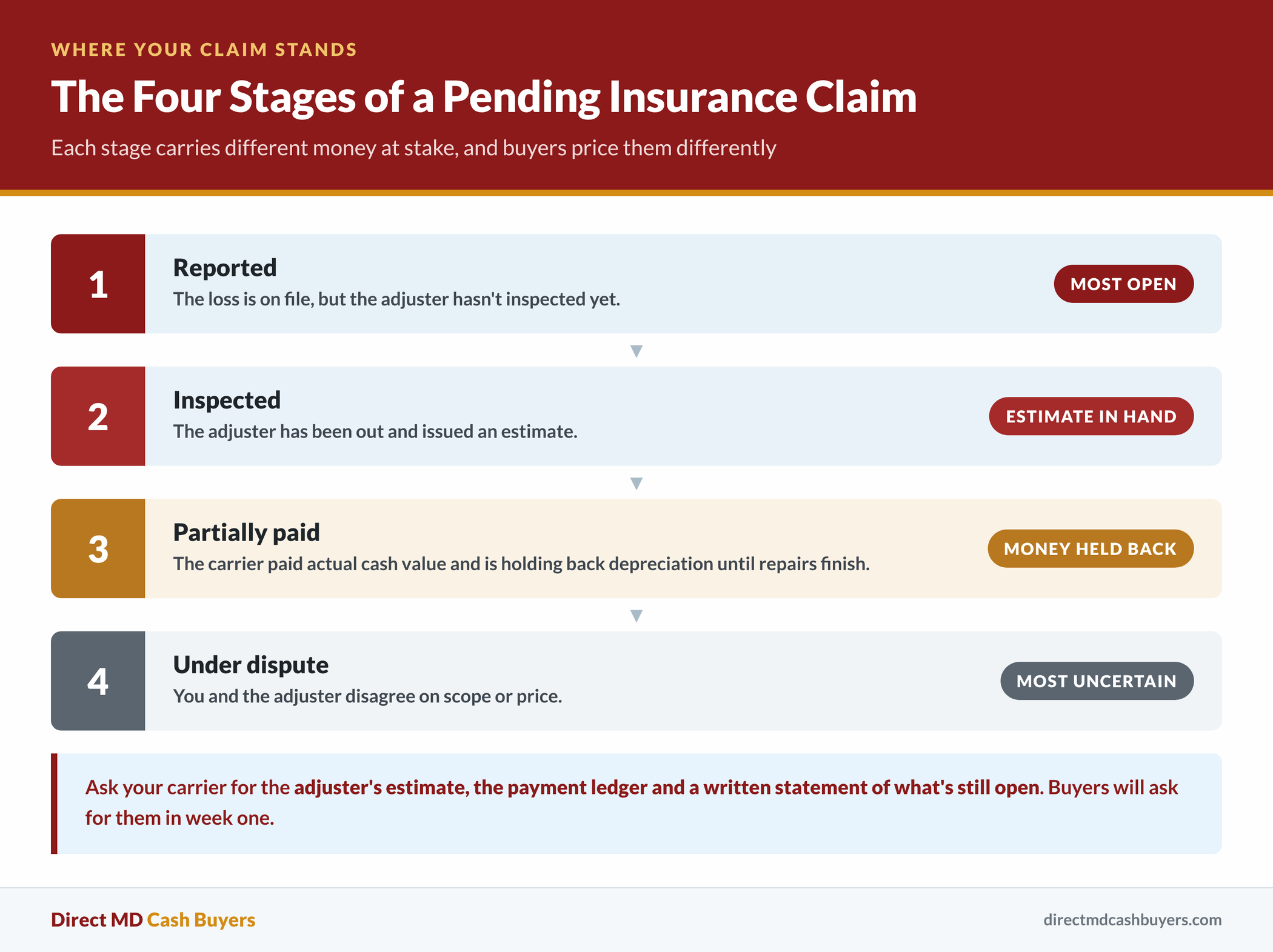
Most claims sit in one of a few states: reported but not yet inspected, inspected with an estimate, partially paid, or under dispute. Partially paid means the carrier sent actual cash value and is holding back the depreciation until repairs finish. Under dispute means you and the adjuster can’t agree on scope or price.
Each state of a pending insurance claim puts its own money at stake, and buyers price each one differently. A disputed water loss with mold questions hanging over it is its own animal.
A claim can touch title through its cousins, though. One is a recorded mechanic’s lien from a contractor who tore off half your roof and never got paid. The other is a lender escrow restriction tied to the loan.
Ask your carrier for the claim file in writing. That means the adjuster’s estimate, the payment ledger, and a written statement of what’s still open. You’ll need those papers whichever path you pick, and buyers will ask for them in week one of the sale.
Why a Pending Insurance Claim Scares Off Buyers and Lenders
One seller called me after her third buyer walked. Water had come through an upstairs bathroom, the claim had been open five months, and each buyer’s lender asked the same thing: who’s finishing the repairs, and when?
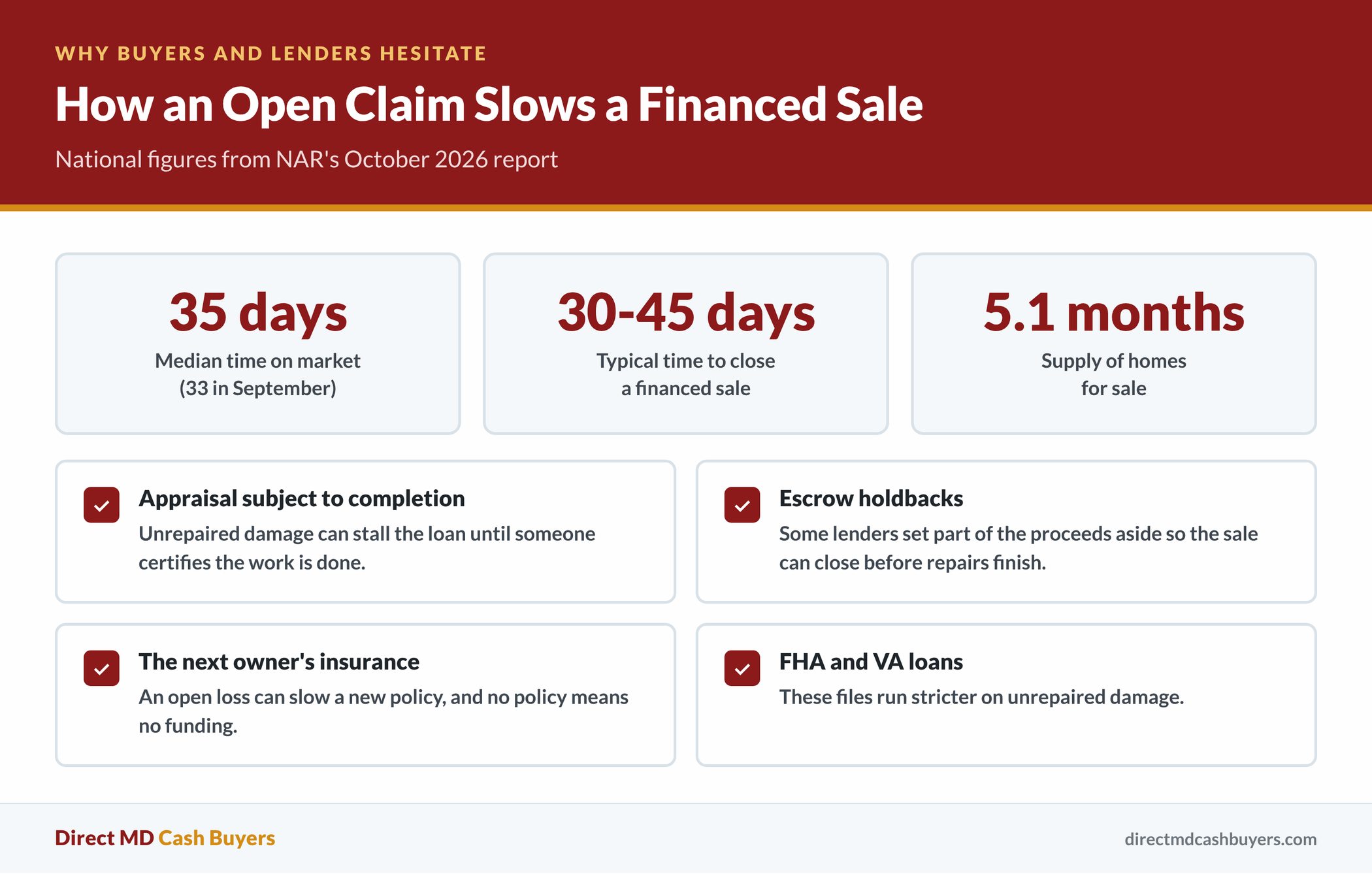
Appraisers who spot unrepaired damage often write the appraisal subject to completion, and the loan stalls until somebody certifies the work is done. FHA and VA files run even stricter.
Some lenders allow an escrow holdback. Part of the sale proceeds gets set aside for repairs, and the sale closes while the work wraps up afterward.
According to the National Association of Realtors, homes took a median of 35 days to go under contract in October 2026. That was up from 33 days in September. Add 30 to 45 days to close a financed sale, and you’re close to three months past listing day. A pending insurance claim that drags beyond that window usually means a price cut or an extension. Sometimes the sale just falls apart.
Sellers underrate one worry on the buyer’s side: can the next owner get insured? Carriers check a property’s loss history before writing a new policy. An open loss can hold up binding that policy, and no policy means no funding.
How Does an Open Insurance Claim Affect Title Insurance for Sellers?
In most states, title insurance premiums run a few thousand dollars on a median-priced home. Not one dollar of that premium covers storm damage. Title policies protect ownership. They cover liens, forged deeds, missing heirs and boundary disputes.
On its own, then, a pending insurance claim won’t stop a title company from issuing a policy.
The paperwork around a pending insurance claim is what can stop them. If you’re assigning proceeds to your buyer, the title agent will want the signed assignment and the carrier’s sign-off, and sometimes the mortgage servicer’s written consent.
Expect the underwriter to ask for lien waivers from each contractor who touched the property. A mitigation company that hauled fans out of your basement in February can still file against the property months later if the carrier shorted them.
I’d push back on the usual advice to let the title company sort it out at closing. From what I’ve seen buying houses, sales move faster when sellers send claim documents to the title agent the day they go under contract, not three days before the walkthrough. Sellers who get paperwork in early close on schedule, and sellers who sit on the file get calendar surprises.
Direct MD Cash Buyers and other seasoned local buyers work through claim assignments with title companies all the time. The documentation side moves faster than it does when a first-time buyer’s loan officer is learning the process live.
Common Insurance Claim Issues That Delay Maryland Home Sales
Depreciation holdbacks cause the most trouble. Your carrier pays actual cash value first and sits on the recoverable depreciation until you prove the repairs happened. Sell before repairing and that holdback may never get released. Your settlement sheet then shows a smaller number than your estimate did.
Supplemental claims slow things down as well. When a contractor opens a wall and finds more damage than the first estimate covered, the carrier has to review and approve that added scope before it pays.
Transfer rules depend on which state’s carrier you’re working with and what the policy says. Some policies ban assignment outright, others need the insurer’s written approval, and a few allow post-loss assignment freely. The National Association of Insurance Commissioners keeps a directory of every state regulator, and your state’s insurance department can explain how assignment works where you live.
Scope disputes add time too. You say the whole roof, the adjuster says three slopes. Appraisal clauses and public adjusters can settle that fight, though either one adds weeks, at times months.
Vacancy clauses catch landlords and heirs off guard. Leave a house empty past the window in your policy, usually 30 or 60 days depending on the form, and coverage for new losses can stop cold.
Then there’s unpermitted repair work. A seller patches the damage to speed things up. Later the carrier denies the supplement because the evidence is gone, and the buyer’s inspector flags the work anyway.
What Are My Responsibilities as a Seller with an Active Claim?
One seller kept quiet with her buyer about a fire claim because the kitchen looked fine by then. The buyer’s inspector found charred framing behind fresh drywall, and the sale fell apart two days before closing.
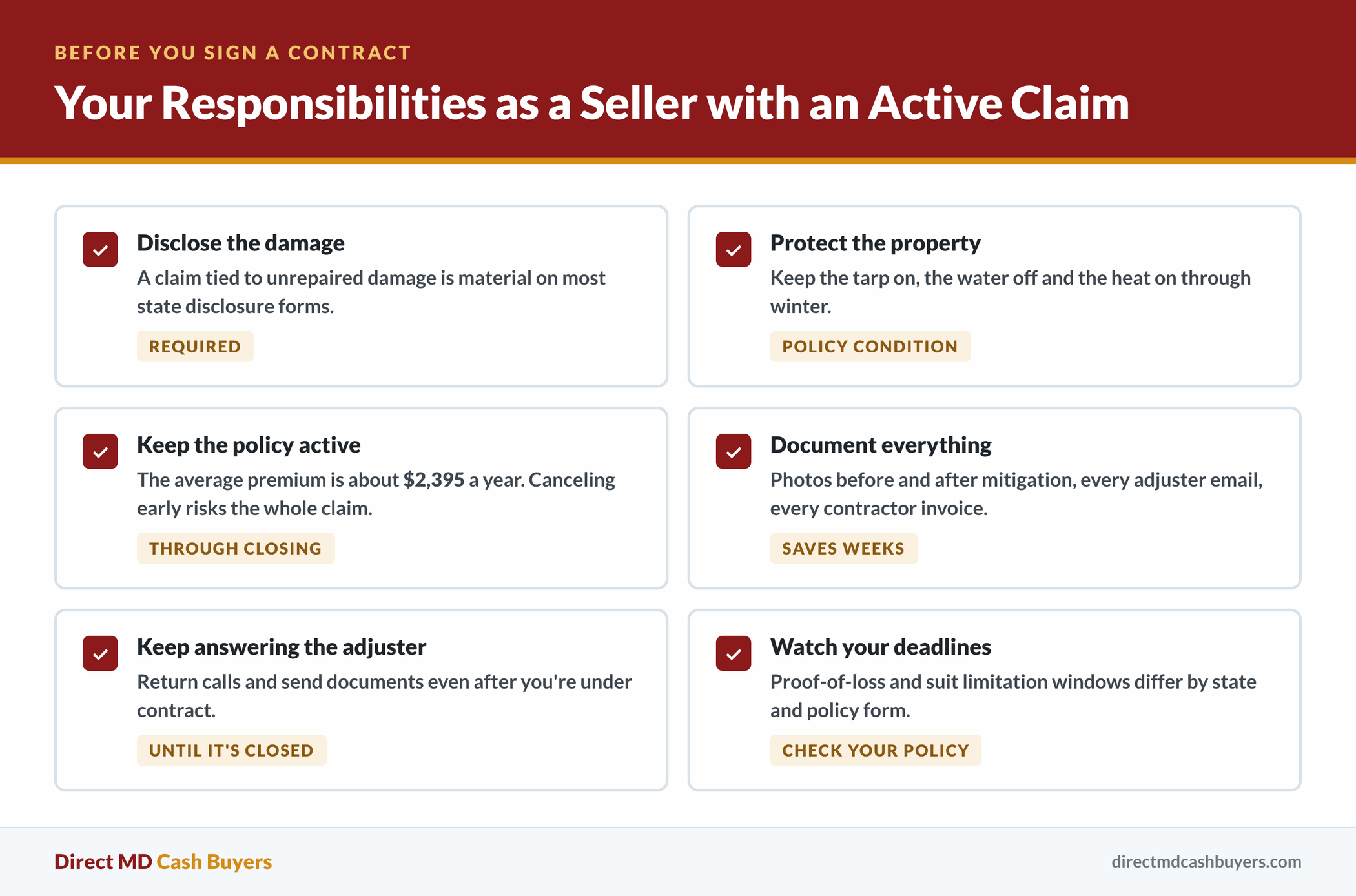
Disclosure duties differ by state, and most states make sellers reveal known material defects on a written disclosure form. A pending insurance claim tied to unrepaired damage counts as material under nearly any reading. Your state real estate commission publishes the required form. A real estate attorney can tell you how courts in your state have treated claim disclosure.
Hiding a claim to skip one awkward conversation is a bad trade.
You’re also on the hook for protecting the property while the claim is open. Policies require reasonable steps to prevent more damage. Keep the tarp on and the water off, and keep the heat running through winter.
Keep the policy active through closing. Dropping it early to save a couple months of premium tends to backfire, and it’s worst on vacant inherited properties where no one wants to keep paying. LendingTree’s February 2026 analysis of rate filings put the average U.S. homeowners premium at about $2,395 a year. Dropping it saves you a few hundred dollars and puts the entire claim at risk.
Save everything, from photos before and after mitigation to each adjuster email and contractor invoice. When a buyer’s lender wants proof of repair scope in week three, that folder gets you a quick answer instead of a two-week delay.
Should I Settle My Claim Before Listing, or Sell As-is?
“Why would I give a buyer my insurance money when I could fix the house myself and sell it for more?”
Fair question. Fixing it means fronting contractor costs and managing a job you may not live near, all while carrying the mortgage, taxes, and premium.
Sellers should weigh market conditions too. Existing-home sales fell to a 3.75 million annual pace in October 2026, the slowest since 2010, and inventory hit a 5.1-month supply per NAR’s October report. With more listings to choose from, buyers have less patience for a house with an open file.
Selling as-is with a pending insurance claim is fairly simple when the buyer pays cash and knows the process. You disclose the condition and price the house around it. Then you either keep the proceeds or assign them.
Pricing cuts both ways and should be honest. A cash buyer knocks off for repair cost and risk.
I’d settle a small, undisputed claim before listing. Think roof hail or a one-room water loss with a clear scope and a cooperative adjuster. If it’s disputed or structural, or your contractor has gone quiet, sell as-is and let a buyer who handles damaged property take on the uncertainty.
Do Not Let an Insurance Claim Lapse Before You Sell
No one mentions one deadline until it’s already gone by, and that’s your policy’s suit limitation and proof-of-loss windows. Carriers set time limits for filing proof of loss and for suing over a denied claim. Those periods vary by state and by policy form. Your declarations page spells out yours. The state insurance department can confirm the minimum where your property sits.
Let a pending insurance claim sit untouched and carriers close the file once it goes quiet. Getting it reopened is a slog.
Keep responding to the adjuster even if your house is under contract. Return the calls, send the documents, and sign the sworn statement. Walk away from a claim mid-sale and you leave your own money on the table, and your buyer can’t recover it either if the assignment never got acknowledged.
Filing a claim has a cost of its own. Your loss history follows you and the property for years, and buyers’ carriers see it. If the repair sits near your deductible, paying cash and never filing might leave you ahead, since one small claim can shadow the property’s history long after the roof gets fixed. That same LendingTree analysis found the national average premium has climbed 46.8% since 2020, and claims history is one of the levers carriers pull.
A landlord in Hagerstown called me on a Tuesday last fall. His mother had just moved into assisted living, and he was driving two hours each way to look after her. On his duplex, a burst pipe claim sat half-finished with a dehumidifier still humming in the downstairs unit. We took it with the claim open. Inside three weeks, he was free of it.
Stretched thin between caregiving, work, and a damaged property? Talking with a buyer who’s handled a pending insurance claim before can save you more than money. Direct MD Cash Buyers often walks sellers through the assignment and the forms that go with it, which keeps the whole process from landing on you.
Frequently Asked Questions
Does a Pending Insurance Claim Show Up on a Title Search?
No. Your carrier doesn’t record a claim in the land records, so a title search won’t turn it up. That still doesn’t make it safe to leave out. If the claim ties to damage that was never repaired, most state disclosure forms expect you to mention it. Watch for liens, though. A contractor who wasn’t paid for claim work can record a mechanic’s lien, and that one will show up.
Should I Cancel My Homeowners Insurance Before Closing?
Keep it. Your policy should stay in force until the sale records and the keys change hands. While the claim is open, your carrier expects you to protect the house, and an empty house can bump into your policy’s vacancy limits. Dropping coverage early also puts the open claim at risk. Call your agent and cancel after closing.
What Happens to Recoverable Depreciation If I Sell Before Repairs?
Usually you lose it. Most policies pay actual cash value first and release the held-back depreciation only after you prove the repairs are done. If the house sells before that work happens, the carrier may never pay the rest. Some sellers get around this by assigning the claim to the buyer, who finishes the work and collects, as long as your policy allows the transfer.
What Should I Avoid Saying to a Home Insurance Adjuster?
Don’t guess at what caused the damage, and don’t say “I’m fine” or “it’s not that bad” before you know how far it goes. Hold off on taking a settlement figure on the spot or signing anything that calls the loss resolved until you’ve seen the written estimate. Stick to facts you can document and put answers in writing. If you don’t know something, say you’ll follow up.
Will Selling with a Pending Insurance Claim Lower My Price?
It can, though often not by much. With a documented scope and proceeds assigned cleanly, buyers price the house close to its repaired value minus the real cost of the work. Prices fall further when the claim is disputed or the damage scope is fuzzy. A carrier that’s gone quiet hurts too, since whoever takes it on prices each unknown as risk.
Who Gets the Insurance Money When the House Sells?
Your purchase contract decides that. You can keep the proceeds and sell the home at its damaged value, or assign the remaining claim to the buyer for a price adjustment. If a mortgage is still on the property, the payoff at closing settles your lender’s interest in the funds. Anything left over goes to whoever the contract names.
Sitting on a damaged house, a half-finished claim, and a calendar that won’t wait? We’re glad to talk it through with you. Bring the adjuster’s estimate if you have one, or just your questions if you don’t. We’ll tell you straight whether repairing first or selling as-is puts more money in your pocket. No pressure if you’d rather wait.
Open Claims and the Baltimore Area Market
Baltimore metro homes are taking longer to sell this year. Redfin’s mid-year review put median days on market at 39, roughly eight days slower than a year before.
An open claim makes a house feel that slowdown first, since lenders and buyers want answers before they commit. Direct MD Cash Buyers buys houses around Baltimore with claims still open. We’ll work through the claim paperwork with you.
Talk Through Your Open Claim With Us
Tell us where the claim stands, and have the adjuster’s estimate nearby if you’ve got one. We’ll make you a cash offer that reflects the work still left to do.
You can contact our team or fill out the short form below. You don’t have to take the offer.
Helpful Maryland Blog Articles
- How Soon Can You Sell Your House After Chapter 7 Bankruptcy
- How Maryland Homeowners Can Sell a House with Septic Tank Problems
- Selling a Fire-Damaged House in Maryland
- Can Medical Bills Take Your House in Maryland?
- How to Get Rid of an Unsellable House
- How to Take Your House Off the Market in Maryland
- How to Find a Realtor in Another State
- Cheapest Places to Live in Maryland
- How to Sell a Maryland House with a Wet Crawl Space
- Can You Sell a House with a Lis Pendens on the Title
- Can I Sell My House With a Pending Insurance Claim
- Cost to List on MLS in Maryland